

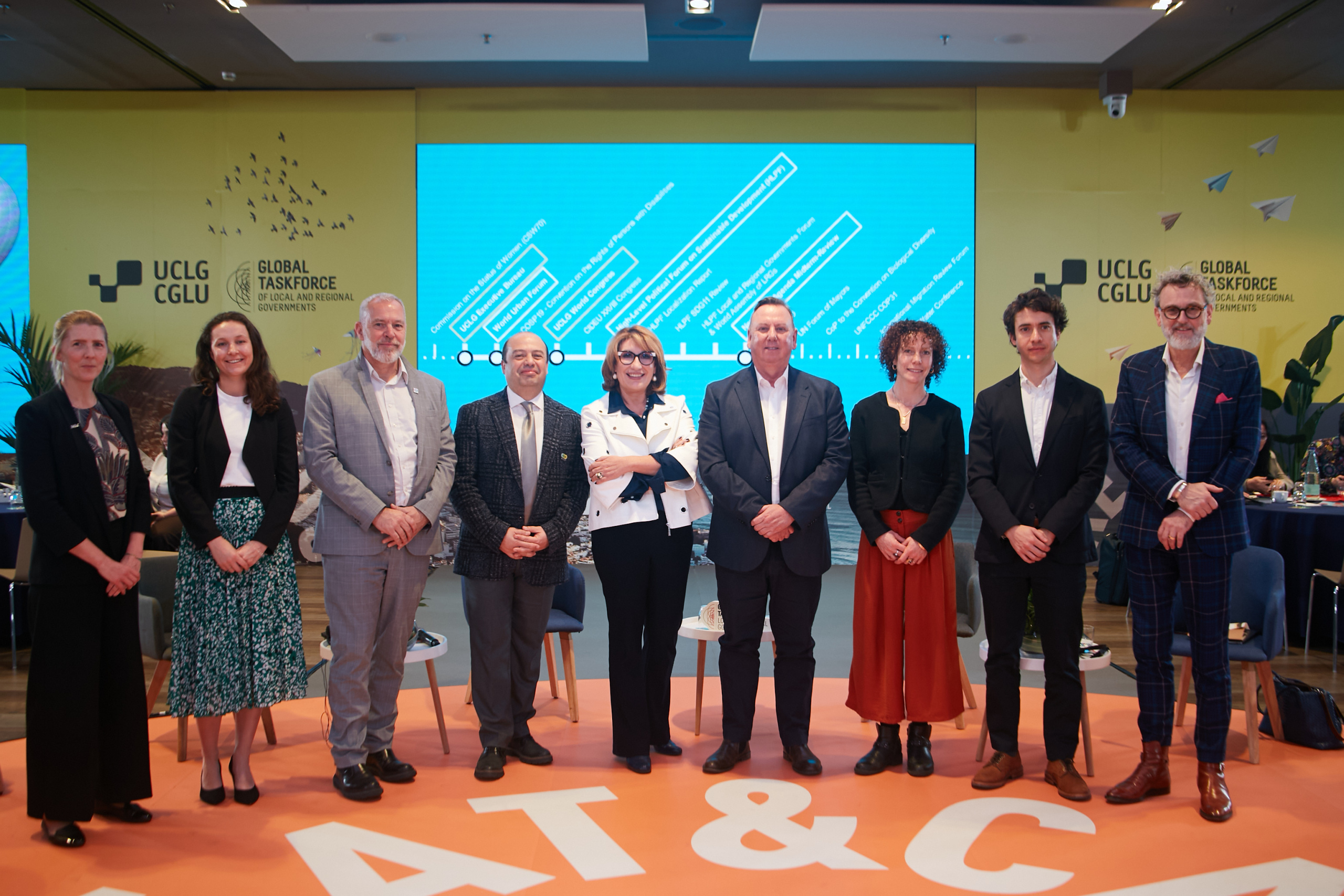
The United Cities and Local Governments (UCLG) Annual Retreat opened its second day, the first with public discussions, with a practical question: how can cities and regions continue strengthening their influence in global decision-making at a time when multilateral institutions themselves are under strain?
The session, titled “100 Days of Local Multilateralism”, brought together leaders from local and regional government networks to take stock of where the movement stands—and what it can realistically shift over the coming months.
In her opening remarks, UCLG Secretary-General Emilia Saiz described the current moment as one of deep uncertainty for international cooperation. She argued that local multilateralism offers a way to engage globally when existing frameworks are under pressure, and that periods of instability can also create space for political and institutional reform. Saiz recalled that the municipal movement has, for more than a century, argued for local and regional governments to be recognised not only as implementers of global agendas, but as political actors in their own right within international decision-making.
The “100 Days of Local Multilateralism” initiative is intended to bring greater coherence to advocacy across a crowded calendar of global milestones in 2026, including the Commission on the Status of Women (CSW), the High-Level Political Forum (HLPF), the midterm review of the New Urban Agenda, the World Urban Forum (WUF), and the UCLG World Congress and World Summit of Local and Regional Leaders in Tangier, alongside major processes on climate, gender equality and migration.
The structured process will begin on 21 April and conclude on 30 July 2026, with the aim of converging into a single collective agenda that channels the political will and diverse visions of communities across regions, and builds towards the UCLG World Congress in Tangier as the political high point of the 100 Days campaign.
For participants in the room, the challenge was not a lack of entry points, but how to use them strategically. Several speakers returned to the same concern: with so many global processes underway, local government networks risk spreading their efforts too thin. Saiz cautioned that “not all of us need to be everywhere,” calling instead for clearer choices about where to invest collective political capital. The aim, she said, is to assert local and regional governments as a sphere of government within multilateralism, backed by joint political messages carried into key global moments.
Calls for prioritisation were closely linked to the need for stronger coordination in a difficult political climate. Gino Van Begin, Secretary-General of ICLEI and member of the Global Taskforce of Local and Regional Governments, warned that many local government networks are operating in an increasingly hostile political environment, where democratic norms are under pressure and civic space is shrinking. “We see a decline of democracy, and we may be outraged by the things that are happening in the world today, but that means we need to come together even more than before,” he said. Multilateralism, he added, needs “to have input from multi-levels” if international cooperation is to remain credible and connected to people’s realities.
Lucy Slack, Secretary-General of the Commonwealth Local Government Forum (CLGF), looked back on the evolution of the Global Task Force since its creation in 2012. She recalled that early cooperation among local government organisations was marked by competition rather than collaboration. “We started the Global Task Force way back in 2012, and the local government community looked very different then,” she said. Today, she noted, the Task Force finds itself in a more fragile global context, one that may require a strategic “reset” to sharpen its political positioning and maximise impact.
Several participants linked this strategic focus to longer-term institutional demands. Speakers referred to ongoing efforts to secure more structured recognition of local and regional governments within the multilateral system, including discussions connected to United Nations reform processes, Article 55 of the United Nations Charter, and the role of the Local and Regional Governments Advisory Group. The objective, they argued, is to move beyond ad hoc participation towards more stable forms of representation that reflect the role of local governments as democratic institutions, not simply delivery partners.
While the session focused on governance reform, speakers repeatedly grounded their arguments in concrete policy domains, illustrating how global agendas intersect in cities and territories. Gender equality, climate action, migration, urban development and democratic renewal were presented not as separate files, but as interconnected fronts in the effort to renew multilateralism.
Nozibele Makanda of the South African Local Government Association (SALGA) pointed to the Commission on the Status of Women as a key political entry point for feminist municipalism. “Women’s leadership at the local level is not symbolic. It is structural to inclusive governance,” she said, adding that justice is delivered through proximity, participation and public services.
Álvaro Soldevila of the Resilient Cities Network linked SDG 11 to public trust in institutions. “When we’re not delivering what we are supposed to do and we are losing the trust of people,” he said. “SDG 11 is not only about urban planning. In the moment that we’re living today, it’s about equity; it’s about democracy.”
Caroline Twigg of the Mayors Migration Council echoed the need for integrated approaches, noting that city-level commitments on migration intersect directly with housing, healthcare and economic inclusion.
The “100 Days” timeline was also framed as a way to align political advocacy with concrete delivery challenges. Speakers pointed to moments such as the UN Water Conference, the Conference of States Parties to the Convention on the Rights of Persons with Disabilities (COSP), the New Urban Agenda midterm review and the World Urban Forum as opportunities to demonstrate how global commitments translate into local public services, accessibility, financing and investment choices. Eugenio Amato from Regions4 stressed the importance of bringing concrete local solutions and investment examples into global reporting processes, while Bárbara Pons Giner of CIDEU warned that many cities face shrinking access to funding at the very moment when expectations on local delivery are expanding. Jordi Pascual of UCLG added that the UCLG World Congress in Tangier in June 2026 should be understood not only as a convening moment, but as a political decision-making space for consolidating shared positions on multilateral reform, public services and rights.
Shelley Nania of C40 highlighted how recent G20 cycles have narrowed formal spaces for city engagement, making it all the more important to sharpen collective positions within Urban 20 and allied platforms. Nicolas Cimbaro of Aude linked the UN Water Conference to the need for stronger recognition of local governments as key actors in water and sanitation governance, arguing that water must be treated as a public good backed by adequate local resources.
Sébastien Vauzelle of the UN Local2030 Coalition and Massimo Perrino, who outlined the pathway from the New Urban Agenda midterm review to the World Urban Forum and the High-Level Political Forum, both stressed the importance of aligning advocacy with concrete local delivery, while Patricia Morla of Villa Carlos Paz linked the “100 Days” agenda to disability rights and inclusion at the local level ahead of COSP.
Participants also pointed to emerging institutional openings as possible building blocks for a renewed multilateral architecture. Rainer Kern, Executive Director of the Global Parliament of Mayors, highlighted the UN Forum of Mayors as an emerging space for dialogue between mayors and the United Nations system. Plurilateral tracks such as Urban 20 (U20) and Urban 7 (U7) were discussed as complementary—but increasingly constrained—avenues for influence. Several speakers cautioned, however, that these formats should not substitute broader multilateral processes, underlining the continued importance of inclusive, universal frameworks.
The session closed with agreement that the “100 Days of Local Multilateralism” should culminate in a concise political roadmap for the Global Task Force, including joint messages and collective statements to be carried into major global forums. Participants stressed that the initiative should not become only a branding exercise, but a coordinated effort to secure lasting political recognition for local and regional governments as a core pillar of renewed multilateral governance.
For those in the room, the discussion marked a moment of collective stocktaking, but also of strategic reckoning about what it will take to turn access into influence. For readers following from a distance, it offers a window into how local and regional governments are seeking to move from participation in global debates to a more structured political role within them—at a time when the credibility of multilateral cooperation increasingly depends on what happens in cities and territories, where global commitments meet everyday realities.