

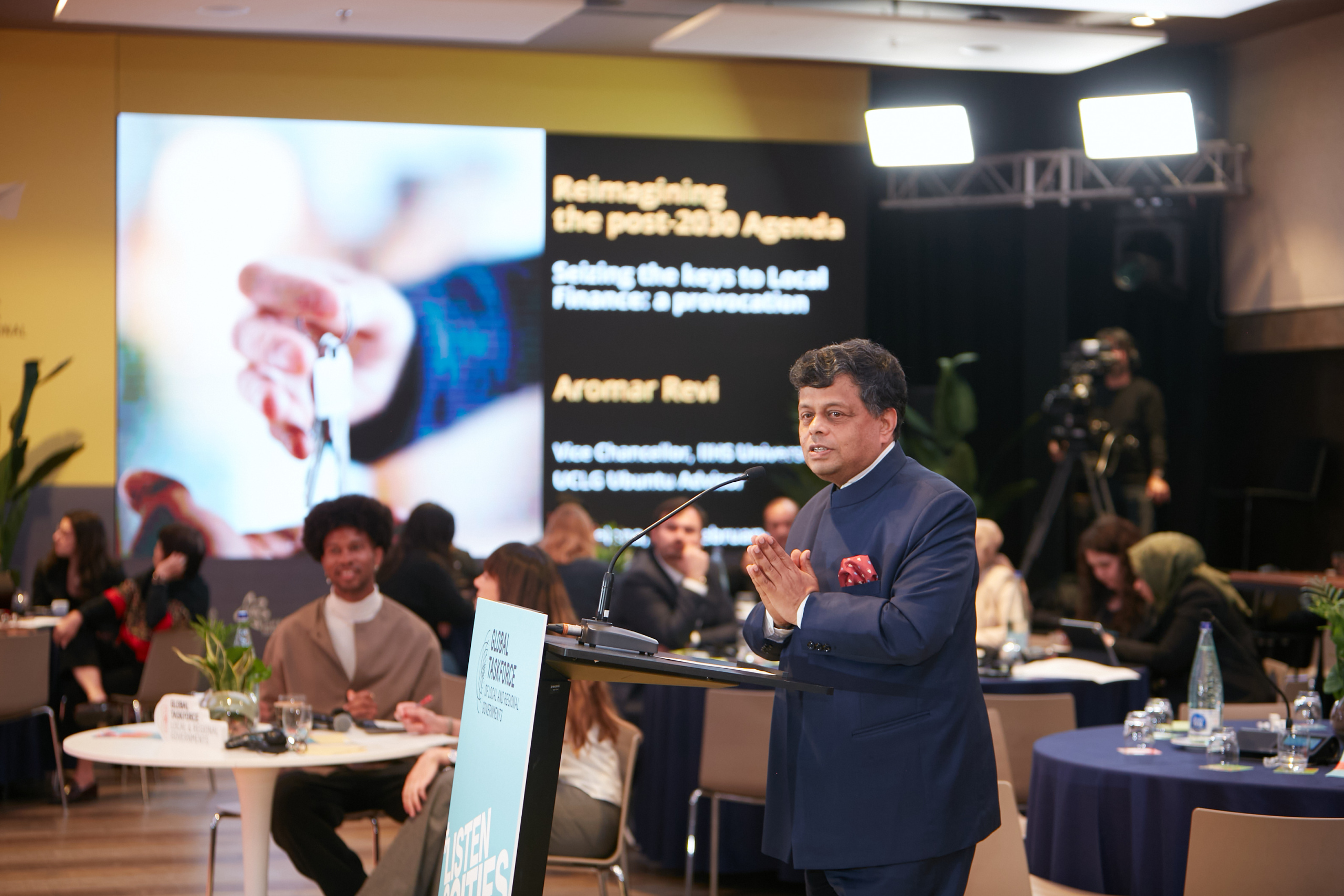
The day’s boldest proposal came from Aromar Revi, Director of the Indian Institute for Human Settlements, who argued that local and regional governments need their own high-grade financial engine: a Global Municipal Development Bank, designed to be AAA-rated and capable of delivering the Pact for the Future and the SDGs through “bankable urban blueprints.”
Revi described a three-layer structure aimed at credit strength and scale. In his outline, cities would be the “owners,” with paid-in and callable capital; a select group of countries would act as “anchors” by providing sovereign guarantees; and additional “fuel” would enable bond issuance and project pipelines. The pitch emphasized speed—breaking “clearance bottlenecks” with a six-to-nine-month approval cycle—and a governance model meant to preserve local decision-making: a board with regional city directors holding voting rights, while countries would intervene only on systemic risk, not on project choices.
But Revi’s most political argument was about sovereignty—specifically, the financial sovereignty of cities. He framed it through a set of rights: the ability to borrow on municipal merits, revenue ownership, digital sovereignty, and a pledge of “legal non-derogation”—the claim that a city’s resources should not be arbitrarily appropriated. His bottom line: cities can become “bankable,” moving “up the elevator,” and could even see dividends within five years, creating incentives for participation.
The proposed timeline was concrete: adopt a charter, set up city audits, and “launch the first bond in 2027.” Revi also extended an invitation to a signing ceremony at the UCLG World Congress in Tangier in June 2026, placing the idea squarely within UCLG’s political calendar.
Public Services International’s Daria Cibrario cautioned against framing cities as companies, pointing to the existence of hundreds of public banks and vast public banking assets worldwide. The debate, she argued, is not only about creating new institutions, but about governance models and values. Emilia Saiz welcomed the ambition but named two barriers drawn from past attempts: the inclusion of smaller cities and, above all, trust. Even if “numbers may allow us to move,” she said, communities may not yet trust local governments to invest at that scale—suggesting that bold finance will only work if matched by democratic legitimacy and partnership with civil society.
Revi returned in the wrap-up with a final provocation: “We could not approve the SDGs these days.” His message to local leaders was to use UCLG’s mandate, grounded in UN principles—and, as he put it, “take it and run with it.”