

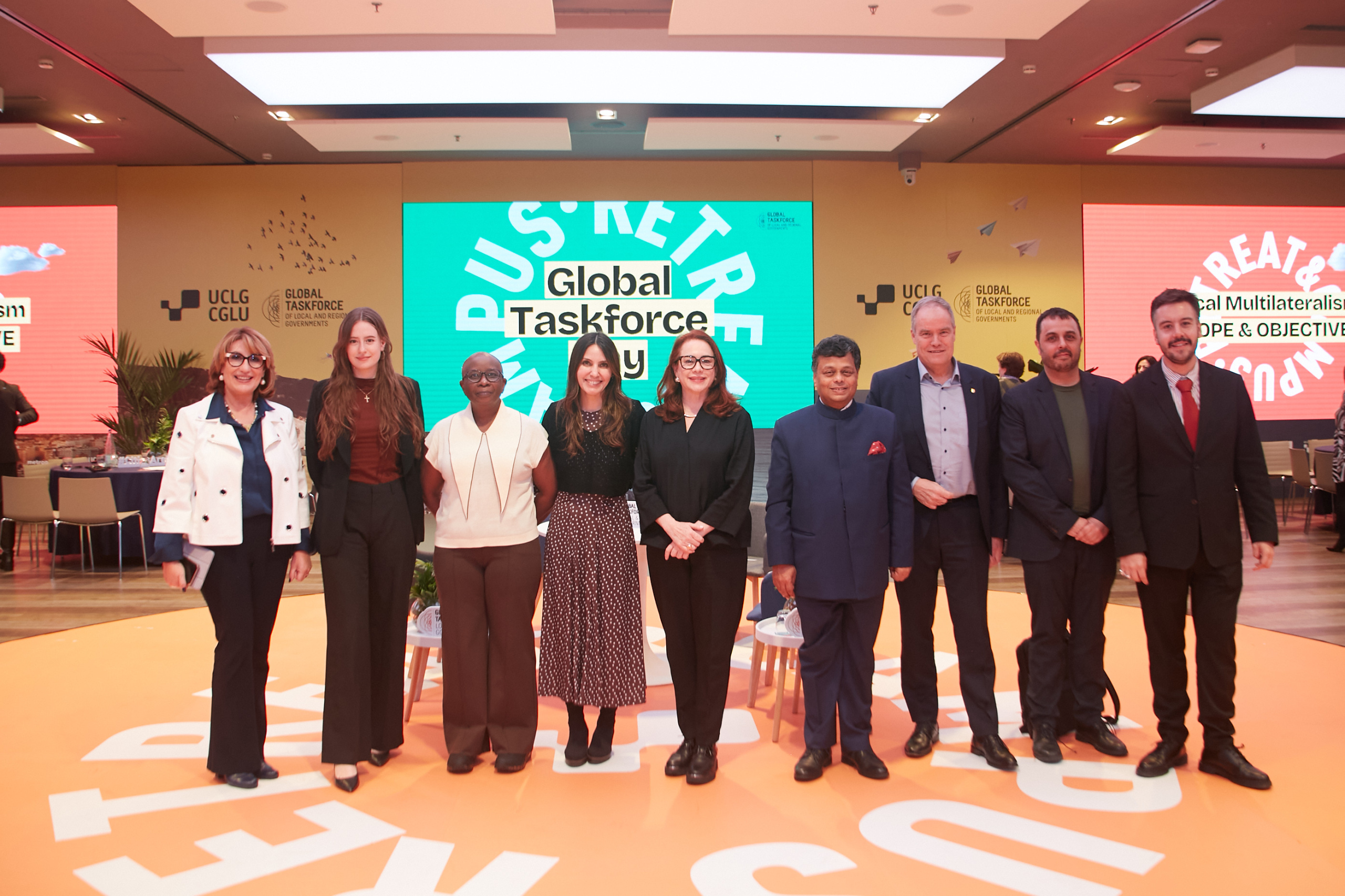
What happens after 2030—and what kind of multilateral system will local and regional governments be operating in by 2036, when the New Urban Agenda is next reviewed?
That question framed the final session of the second day of the UCLG Retreat, where participants were asked to imagine four possible futures: a continuation of the current global framework, a renewed one, a fragmented system of regional or sectoral arrangements, or a world with no shared framework at all. The exercise was not about prediction, but preparation— clarifying positions, identifying allies and testing how the emerging Local Social Covenant might guide local action in uncertain global conditions.
For Spain’s Director-General for the 2030 Agenda, David Perejil, the message was to avoid fatalism. “We are a decentralised country and it’s not always easy,” he said. “But this is a unique opportunity to reflect together on global public goods and the shared responsibilities we face.” He warned that the principle of “leave no one behind” is under pressure and called for stronger alliances grounded in a feminist care perspective. Spain’s own new sustainable development strategy, with 100 actions—75 of them going beyond the SDGs—was cited as an attempt to keep equity and care central to the post-2030 transition.
Perejil outlined three priorities: stay focused on delivery to 2030, begin shaping post-2030 content now, and reclaim the political meaning of “leave no one behind” as a rights-based commitment that addresses climate, economic and gender inequalities. “Let’s continue working between now and 2030—that’s most important,” he said. “But we also need to start adding localised demands into what comes next.”
Questions of trust and political credibility ran through the session. Eckart Würzner, Mayor of Heidelberg and Chair of the UN Forum of Mayors, argued that local leadership will matter even more in a fragmented global system. “Nearly everybody trusts local leaders,” he said. “After 2030, it’s not just about frameworks. It’s about who people trust.” He also challenged local government networks to sharpen their political communication. “If our concerns are not in the media—if they’re not in newspapers like The New York Times or Süddeutsche Zeitung—then we’re not communicating strongly enough.”
For UCLG Secretary-General Emilia Saiz, the risk is not only fragmentation, but resignation. “We shouldn’t assume that frameworks won’t exist,” she said. The SDGs, she argued, have provided three things that should not be lost: a shared political language, momentum on climate finance, and accountability tools. Rather than waiting for a renewed framework, she urged local governments to demonstrate impact now—showing what investments they make and how many people they serve. “Development will only work through a new generation of public service delivery,” she said.
The session’s futures exercise brought together perspectives on multilateralism, finance, trust and feminism. María Fernanda Espinosa, Executive Director of GWL Voices, framed the broader geopolitical moment as one of transition rather than collapse. “Multilateralism is collaboration, solidarity and collective action for the common good,” she said. But she warned that legitimacy and performance gaps are widening, calling for a system that looks more like the societies it is meant to serve— anchored in local power and delivery capacity.
Other interventions sharpened the thematic stakes. Aromar Revi, Director of the Indian Institute for Human Settlements, argued that post-2030 debates will need to tackle global finance architecture if cities are to deliver at scale. Lauren Banham of Stop Ecocide International focused on trust and accountability as prerequisites for any renewed framework. Rumbidzai Kandawasvika-Nhundu of International IDEA brought a feminist democracy lens, insisting that inclusion, representation and care must be structural features of future governance—not add-ons.
The session closed on cautious optimism. Even in scenarios of fragmentation or weak global coordination, participants argued that local and regional governments remain uniquely positioned to anchor trust, deliver services and defend rights. As Espinosa put it, “We are here because we believe in collective action for the common good.” Würzner echoed the sentiment more plainly: “We believe in the future. Let’s stay together. Let’s find concrete action with our neighbours.”