

In the context of growing democratic erosion, social fragmentation and global uncertainty, trust has become both a foundational value for local governments and one of the defining challenges of political leadership. The session on Trust and Leadership in the DNA of the Movement examined how the municipal movement can renew democratic legitimacy through leadership models grounded in participatory democracy, inclusive governance and a strong human rights–based approach to local public action, as part of the strategic runway towards the 2026 UCLG Congress.
Lorena Zárate, representing the Global Platform for the Right to the City, argued that the political context has shifted fundamentally. “We are not in the neoliberal era anymore,” she said. “We are in a post-liberal moment that is openly autocratic and anti-democratic.” Trust, she warned, is not simply eroding but being actively undermined. “Corporate power and algorithmic control are attacking trust. Women, Indigenous peoples, trade unions and local governments are under attack.” For Zárate, the response must be structural. “We have to recover trust and defend trust. Let’s respond at the same scale — through a plurilateralism that comes from and is for regions, communities and cities. We need to reverse power centralisation trends.”
Practical experiences from Sweden illustrated how trust is built through participation. Anders Henriksson, President of the Swedish Association of Local Authorities and Regions (SALAR), described how municipalities in southern Sweden are creating structured dialogues between social workers and residents to rebuild confidence in public services. In Lund and other cities, youth councils are formally linked to decision-making rather than operating in parallel. “Trust is not just a nice idea,” he said. “It is essential to leadership. What we need now is political courage — leaders who speak openly about problems, who ensure processes are transparent and respectful, and who show citizens that their voices matter.”
UCLG Secretary General Emilia Saiz reflected on what she described as the paradox of trust. “If you ask people whether they trust politicians, many will say no,” she said. “But if you ask whether they trust their water supply, emergency services or public spaces, the answers are very different.” Trust, she argued, is often built through the everyday delivery of public services rather than through abstract political discourse. The challenge for leadership is to connect values to tangible outcomes, and to restore accountability when institutions fail to meet their commitments.
Berry Vrbanovic, Mayor of Kitchener and UCLG CoPresident, framed trust as a practical outcome of everyday governance. Local governments, he argued, are judged less by abstract commitments than by how people experience public services. “Trust is built through transparency, meaningful participation and honest information,” he said. Reliable access to water, care for older adults and children, and the protection of basic rights are not technical issues, but foundations of democratic legitimacy.
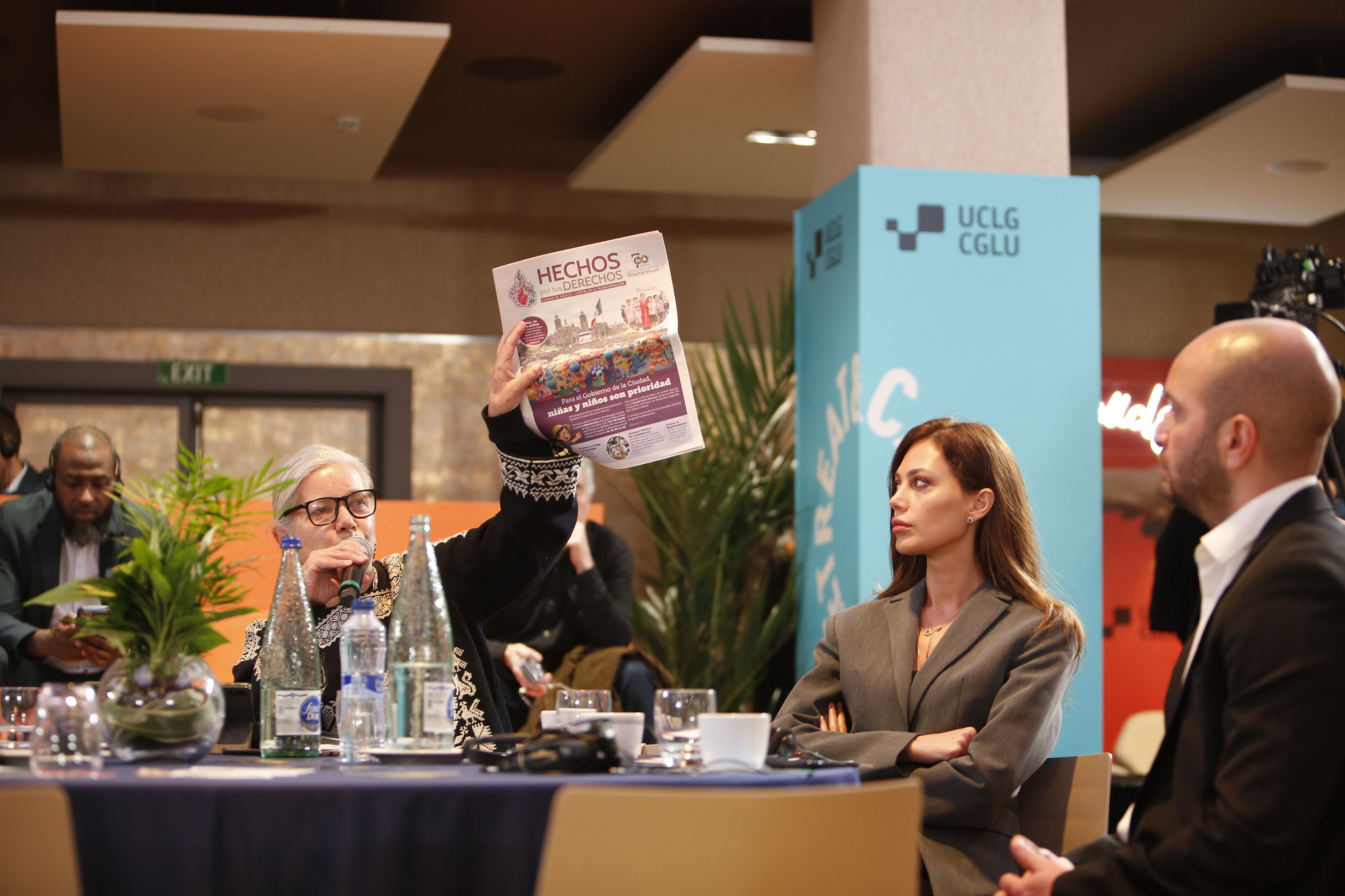
Dignity and human rights were repeatedly highlighted as the normative anchor of trust. Rocío Lombera, representing Mexico City, recalled the opening words of the United Nations Charter: “We, the peoples.” For her, trust is not only proximity but identity and shared purpose. “It is memory and hope. It is the essence of government.” She added that rebuilding trust also means practising “door-to-door government” — restoring proximity by meeting people where they live, not only where institutions convene.
Maria Eugènia Gay, Deputy Mayor of Barcelona, stressed that citizens’ perceptions are shaped by whether public policies are applied fairly and in line with rights. “When principles are applied with dignity and due process, people trust,” she said. “When this breaks down, the space is quickly filled by polarising narratives. Dignity is the boundary for power. The law must affirm that.”
The Vienna Commissioner for Human Rights, Shams Asadi, underlined that trust depends on competence, responsiveness and dignity in public action. When institutions fail to explain decisions or deliver fairly, she noted, legitimacy erodes. “Trust is built when institutions are capable, transparent and respectful of fundamental rights,” she said.
Rodrigo Neves, Mayor of Niterói and President of Mercociudades, linked trust to renewed interregional cooperation. Referring to recent steps to strengthen ties between Latin America and Europe, he argued that commercial and political agreements must be accompanied by local responsibility. “This is about collaboration and shared responsibility,” he said. “Local leadership is what will guarantee sustainability in the long term.”
Jan van Zanen, Mayor of The Hague and member of UCLG’s Executive Presidency, warned that disengagement poses a greater threat to democracy than disagreement. “We cannot allow polarisation to become paralysis,” he said. UCLG, he added, is strongest when it acts as “a community of shared responsibility,” capable of modelling cooperation across political and regional divides.
Looking ahead, Mateusz Płoskonka, representing the City of Kraków, invited members to engage with the 25th Conference of the International Observatory on Participatory Democracy (OIDP), to be held in Kraków in September 2026. Marking 25 years of collective learning on participatory governance, the conference will focus on how care, proximity, democracy and peace can be translated into renewed legitimacy. “Trust is not rebuilt through one single model,” Płoskonka said. “It grows through many local solutions and shared learning.”
Bheki Stofile, President of the South African Local Government Association (SALGA), emphasised coordination as a condition for trust in a context of overlapping crises. “New forms of conflict and climate change do not recognise borders,” he said. “As first responders and long-term rebuilders, municipalities need authority — and we build trust by working well together.”
Closing the exchange, María Fernanda Espinosa’s formulation of a “coalition of the responsible” was cited as a political horizon for the UCLG Congress in Tangier. Global challenges such as climate change, artificial intelligence, outer space and the deep sea, participants noted, require shared rules and shared accountability. Trust, in this framing, is not a sentiment but a political practice — built through rights-based governance, participatory leadership and collective responsibility for the commons.
Pedro Bravo, writer and long-time observer of the municipal movement, closed the exchange with a note of political realism. The current moment, he suggested, is not defined by a single rupture but by overlapping crises — alongside which processes of renewal are also taking shape. For local leaders, the task is to hold both at once: to name democratic erosion clearly while committing to rebuild through cooperation, delivery and shared responsibility.