

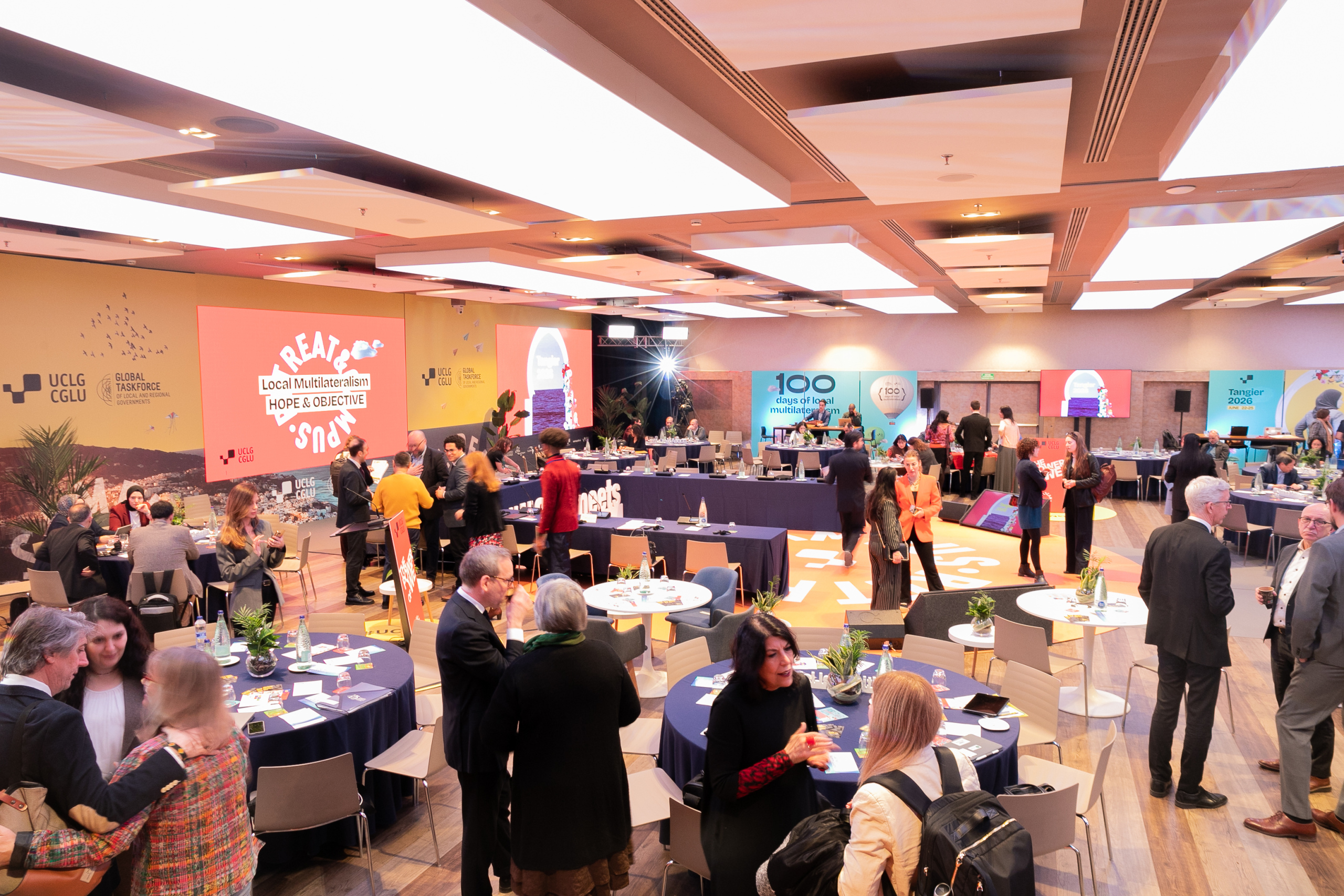
On the third day of the UCLG Annual Retreat in Barcelona, the municipal movement turned to a strategic question shaping its international engagement: how to operate politically in a global order where universal multilateralism is increasingly complemented — and in some cases bypassed — by plurilateral, multi-actor coalitions. The session on Democracy and Plurilateralism examined how cities and regions can engage in these shifting formats without diluting democratic values or fragmenting the movement internally.
Joseph Foti, Principal Advisor for Emerging Issues at the Open Government Partnership, opened the discussion with a blunt diagnosis of the international landscape. “Even the pretense is gone,” he said, referring to the idea that global cooperation still rests primarily on universal forums. In practice, influence is increasingly exercised through coalitions organised around specific issues. For local governments, this creates both opportunity and risk. “If you are not at the table, you are on the menu.”
For Foti, plurilateralism is not the problem. Design is. “Coalitions that go beyond talk must have concrete commitments, timelines and accountability,” he said, arguing that independent monitoring and consequences for non-performance are what distinguish operational alliances from declarative platforms. He pointed to city-led initiatives such as the C40 Cities Climate Leadership Group and OGP Local as examples of plurilateral formats that combine political ambition with reporting and peer review. The political test, he argued, is whether these coalitions are “big enough and designed well enough to solve big global challenges and antidemocracy efforts.”
Emilia Saiz, Secretary General of United Cities and Local Governments (UCLG), placed the debate within the organisation’s own positioning. UCLG, she noted, has long combined universal multilateral engagement with more focused alliances and thematic coalitions. The challenge today is coherence. “We want to change the multilateralism that we have with new actors,” she said, “but we need to overcome fragmentation by defining our objectives.” As agendas become more dispersed, she warned, there is a risk that collective priorities are sidelined by more transactional arrangements. Initiatives such as the Global Taskforce’s 100 Days of Multilateralism, she added, are intended to help the movement “focus on this agenda together,” even when positions differ.
Several speakers underlined that plurilateral engagement must remain explicitly grounded in democratic values. Carola Gunnarsson, VicePresident of the Council of European Municipalities and Regions (CEMR), argued that international cooperation among local and regional governments must be value-based to retain legitimacy. Democracy and the rule of law, she said, must remain the foundation of cooperation, alongside human rights, solidarity, social cohesion, sustainable development and gender equality. Without this normative anchor, she warned, trust in international action erodes.
Concerns about democratic erosion and authoritarian pressure also shaped the discussion. Alfonso Gómez, Mayor of Geneva, warned of the growing influence of autocratic and exclusionary political forces in many contexts. Cities, he argued, are frontline spaces where democracy is practiced daily, and where local leaders and civil society organisations increasingly face pressure. He stressed the importance of protecting independent media and citizen associations, and of ensuring that plurilateral engagement does not become a space where illiberal agendas are normalised.
From Latin America, Rodrigo Neves, Mayor of Niterói and President of Mercociudades, cautioned against reducing plurilateral engagement to voluntary alignment. “Coalitions of the willing are not enough,” he argued. In a fragmented international order, he said, the movement needs “coalitions of the responsible,” grounded in transparency and shared standards of accountability. For Neves, the political challenge is to ensure that plurilateral cooperation produces obligations, not only affiliations.
The session also addressed the institutional implications of a more networked global order. Dario Soto, representing the Global Governance Forum, argued that cities and regions are increasingly implementing global agendas on the ground while remaining structurally underrepresented in formal decision-making spaces. He called on municipalities to engage in debates on United Nations Charter reform and to support initiatives such as Cities for UN Reform, positioning cities as emerging protagonists in reshaping global governance.
Throughout the exchange, speakers returned to a shared concern: the risk that fragmentation in the international system is mirrored within the municipal movement itself. Jan van Zanen, Mayor of The Hague and member of UCLG’s Executive Presidency, argued that in a divided world, the movement must model cooperation across political and regional differences. “Our diversity is our strength,” he said, “but only if we hold it together.” Disagreement, he added, is manageable; disengagement from shared spaces is not.
As UCLG looks toward its upcoming Congress, the debate clarified the strategic terrain ahead. Plurilateral coalitions and networked governance are likely to multiply as universal multilateralism continues to fragment. The political task for cities and regions is not to choose between formats, but to shape them — ensuring that new coalitions extend democratic agency, uphold shared values and reinforce collective coherence rather than weakening the foundations of the municipal movement.