

On the fourth day of the UCLG Annual Retreat, the focus shifted decisively toward June — when Tangier will host the UCLG World Congress and World Summit of Local and Regional Leaders, the movement’s defining political moment of the cycle.
After two days of debate on local multilateralism, democracy and the pressures facing global governance, the question became more concrete: what will the municipal movement deliver there?
The Congress, to be held from 22 to 25 June, is more than a periodic gathering. It is intended as a political milestone — a moment to consolidate how local and regional governments operate within a multilateral system facing fragmentation, and to clarify their role in shaping what comes after 2030.
Opening the session, UCLG Secretary General Emilia Saiz stressed that Tangier must not be a showcase. “We are in Congress year. We want you here, active and participating.” The programme, she noted, has been shaped through a two-year structured dialogue under the Local Social Covenant, linking UCLG Policy Councils and organised civil society around housing, public services, climate justice and finance. “The programme of the Congress is going to answer the letters that we have been exchanging… to the topics that we have at heart” — a reference to the formal written exchanges between political leaders and civil society that have defined the Congress agenda.
Those exchanges are not procedural. They reflect a broader shift that began with the “Cities Listening” process and Town Halls, placing civil society at the table in shaping priorities. Tangier is expected to formalise that mechanism, embedding it into the political outcome of the Congress.
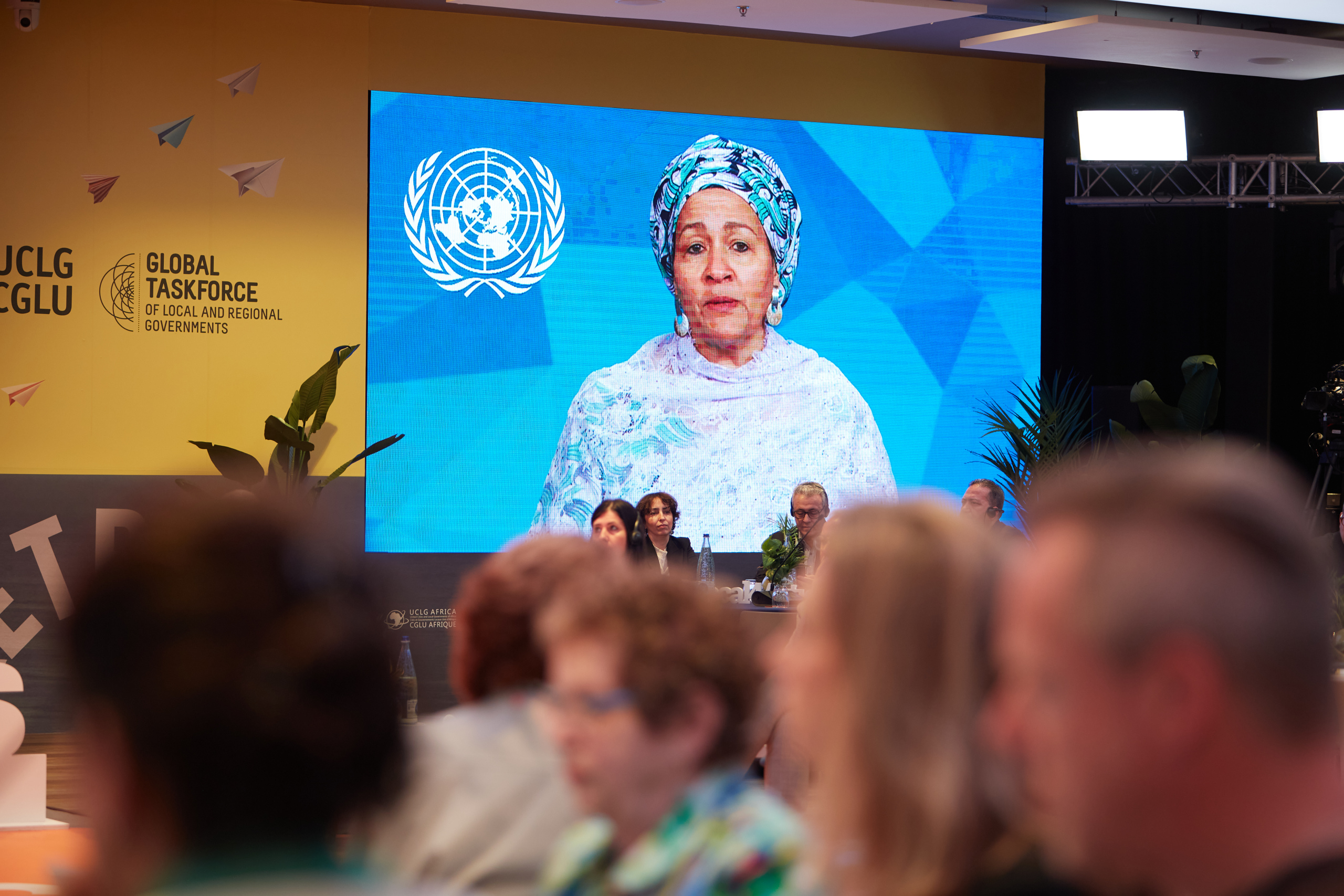
The global context framed the urgency. In a video message, United Nations Deputy Secretary-General Amina Mohammed described a system facing “profound disruption.” Inequalities are deepening, climate shocks intensifying and trust in institutions remains fragile. Yet she pointed directly to local and regional governments as part of the response. “Recognition must translate into meaningful institutional space within the United Nations system commensurate with your responsibilities.” The benchmark, she added, is delivery: “The future of our global system will be judged by delivery — and delivery begins locally.”
The debate in Barcelona built on the themes explored earlier in the Retreat: fragmentation, democratic erosion and the need for coherence. Mandated by the Pact for the Future, the local and regional governments constituency is seeking to consolidate its place within global governance — from the reform of the High-Level Political Forum to the UN80 milestone and the shaping of the post-2030 agenda. The objective is not symbolic recognition, but greater influence on how international decisions are shaped.
That positioning rests on three tracks: strengthening the technical architecture of local and regional government participation in global processes; advancing the political prioritisation of local democracy, territorial cohesion and public services in negotiations; and ensuring a consistent presence across international arenas — from the United Nations to economic and regional platforms.
Agustí Fernández de Losada, Secretary for External Action and the EU of the Government of Catalonia, argued that the crisis of multilateralism should also be read as an opening. Local governments are already advancing solutions on climate, inequality and digital transformation. The challenge, he suggested, is ensuring those solutions are connected to financing and regulatory frameworks. Without that link, innovation risks remaining visible but limited.
Viviana Repetto, Secretary General of Montevideo, spoke from municipal experience. Alignment between local ambition and national frameworks remains uneven. When levels of government are politically misaligned, she warned, citizens can become “hostages of the situation.” Moving “from discourse to action” requires not only political will but structural support.
The strategy is not limited to institutional reform. The Cities Countdown to 2030, highlighted during the session, aims to transform local initiatives into scalable missions aligned with global transitions. Rather than promoting isolated best practices, it seeks to demonstrate that cities are already shaping systemic change — and that these experiences should inform the post-2030 framework.
Throughout the exchanges, one theme persisted: coherence. As the movement expands its engagement across global and plurilateral spaces, it faces the risk of fragmentation internally. The Congress in Tangier is being framed as the moment to align leadership, consolidate shared priorities and clarify how local and regional governments intend to act as full partners in renewing multilateralism.
If the earlier days of the Retreat examined the changing terrain of global cooperation, this session asked a different question: how will the municipal movement position itself within it? The answer will be tested in Tangier — not in declarations, but in whether dialogue, innovation and political ambition translate into durable commitments.