

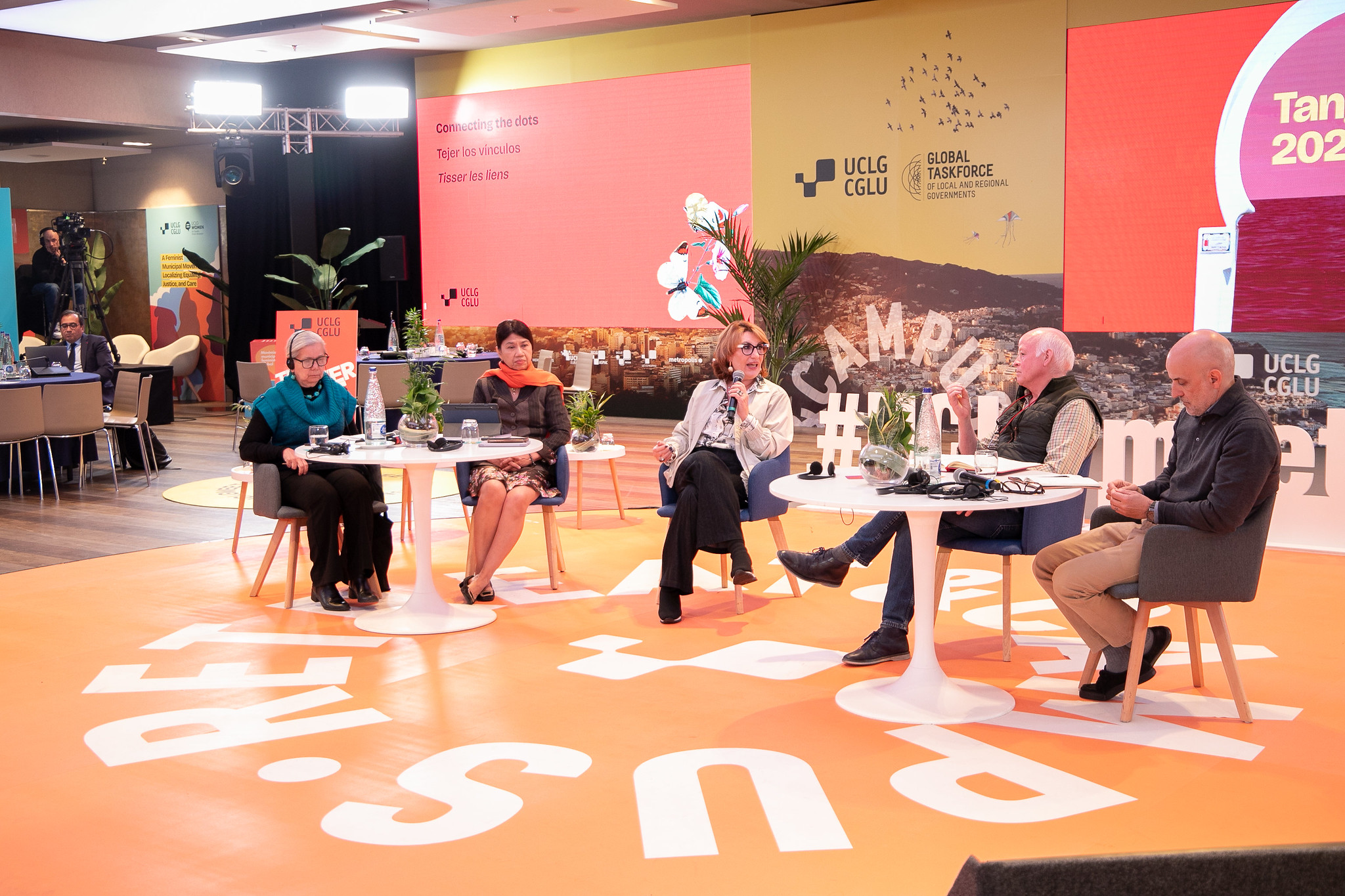
The closing session of the Retreat was less about conclusions than about alignment. After days of debate on plurilateralism, democratic erosion, public services and the road to Tangier, political leaders turned to a central question: how does UCLG remain a space of convergence in a fragmented world without diluting its values?
William Cobbett, UCLG Ubuntu Advisor, challenged local governments to move beyond narratives of exclusion. “A renewed local multilateralism cannot be built on the premise of being left out,” he argued. It must be assertive, accountable and value-based. Universal service provision, in his view, lies at the heart of that positioning.
Expanding the definition of essential services is important, he maintained, but ambition alone is insufficient. Financing remains the structural test. “The dominant call to lower taxes and reduce the public sector is regressive. Public finance should be defended as a positive duty that benefits the majority.” Advocacy for public services must therefore be matched by clarity about how they are funded.
UCLG Secretary General Emilia Saiz approached the issue from another angle. Before debating instruments, she suggested, local governments must clarify what kind of public services they are prepared to defend. Only then can financing models be addressed coherently. She also challenged the language of “free” services, reminding participants that they are collectively paid for — an expression of solidarity rather than charity.
Rocío Lombera, Head of International Affairs of Mexico City, illustrated how this principle translates into practice. Investment in publicly managed service complexes, she noted, demonstrates that universal and accessible provision is achievable when fiscal arrangements capture value for public use and redirect it toward infrastructure.
From the Asia Pacific region, Bernadia Irawati Tjandradewi, Secretary General of UCLG ASPAC, underlined the importance of transparency. In many contexts, subnational governments manage the majority of public service expenditure. Trust depends on clear mandates and visible spending, particularly as climate pressures intensify and expectations around service efficiency rise.
Writer Pedro Bravo added a strategic layer to the discussion, suggesting that cities need not choose between defending universal principles and engaging in flexible alliances. In an uncertain global environment, they may have to operate in parallel arenas — provided their core values remain intact.
Throughout the exchange, ambition and capacity were weighed carefully. Over recent years, local governments have broadened commitments around care, climate and equality. The challenge now is to align that ambition with sustainable financing and political cohesion.
As the Retreat concluded, attention returned to the Congress in June. The week clarified priorities; the task ahead is to translate them into durable commitments. Connecting the dots now means linking values, finance and governance into a coherent strategy — one capable of sustaining the municipal movement’s influence in an increasingly fragmented global order.