

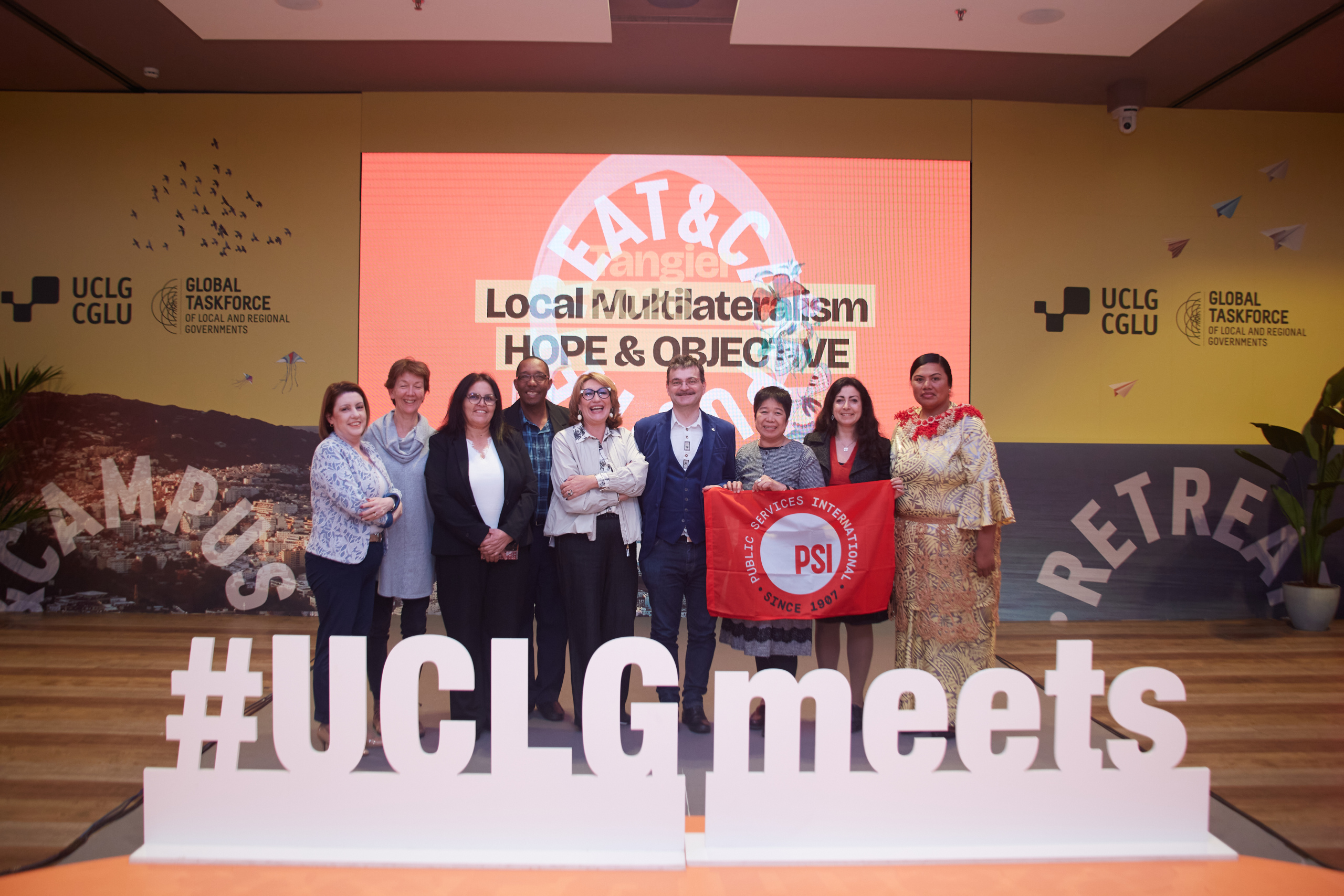
Public services are often discussed in terms of infrastructure, financing and delivery targets. This session shifted the focus to the people who make those services possible. Bringing together local government leaders and trade union representatives, participants examined how dignified treatment of public service workers, grounded in human rights, is inseparable from democracy, effective governance and the localisation of the SDGs.
The discussion formed part of the growing collaboration between UCLG and Public Services International (PSI), which represents public service workers globally. The objective is to establish structured, continuous social dialogue between political leadership and the workforce responsible for health and care, emergency response, water and sanitation, waste management, education, transport, housing and other essential sectors.
Daria Cibrario, Senior Policy Officer at Public Services International, welcomed the recognition that improving public services requires direct dialogue with those who deliver them. “The men and women who provide these services are central to local government responsibility,” she said, describing engagement with workers as “a matter of democracy, but also of effectiveness.” A common space for open and good-faith dialogue, she added, still needs to be fully institutionalised.
Ravi Ranjan, Deputy Director General of the All India Institute of Local Self Government, described the proposed global framework agreement between UCLG and PSI as a significant milestone, aimed at preserving complementary missions through “continuous and structured dialogue, regular exchange and joint advocacy and training opportunities.”
Recognition itself became part of the debate. Sandra van Niekerk, representing Public Services International, noted that this was the first Retreat session dedicated specifically to public service workers. “They are an essential constituency,” she observed, pointing out that frontline staff are often the daily interface between institutions and residents.
Annie Geron, President of PSLINK and Asia Pacific Vice President of PSI, framed the issue more broadly. Free trade unions, she argued, are a proxy for democracy itself. “Workers are bedrocks of democracy. They are voters and citizens.” At a time when labour rights face pressure in many contexts, she maintained that trade unions remain central to reducing inequality and defending social protection systems.
Climate vulnerability added urgency. Steve Joseph, President of the Dominica Public Service Union and member of the PSI Executive Board, recalled the devastation of the 2017 climate crisis, which caused losses equivalent to 226 per cent of GDP. “Public services are essential to the response to the climate crisis,” he said, recounting carrying his mother-inlaw through floodwaters. Decent working conditions and climate safety for workers, he stressed, are inseparable from disaster preparedness.
Financing emerged as a structural concern. Philippe Malaisé, National Secretary of CFDT Interco, argued that high-quality services depend not only on infrastructure investment but on adequate and autonomous local financing for staffing and working conditions. “We need decent work conditions and the right for workers to express themselves and organise,” he said, calling for strengthened local revenue systems, public banking mechanisms and remunicipalisation where necessary.
Concrete experiences illustrated what is at stake. Rebeca Céspedes, National Secretary for Gender and Equality of ANEP and representative of the Municipality of Goicoechea, described how trade unions mobilised against the privatisation of waste collection, ultimately returning the service to public control. “Citizens are our reason for being,” she said. “We want to give them the best services they deserve.” Nadia Koubia, representing the Municipality of Al Hoceima, similarly emphasised waste management as a public health priority that cannot be reduced to profitability, highlighting remunicipalisation, gender equality and recognition of informal workers as necessary steps.
Throughout the exchanges, one message remained consistent: dignified working conditions are not separate from service quality but integral to it. Public service workers are not merely implementers of policy, but rights holders and democratic actors in their own right.
On 23 June, the International Day of Public Service, UCLG and PSI leadership are expected to formalise their mechanism for structured dialogue. As preparations continue toward the Congress, the test will not only be the ambition of local commitments, but whether those who deliver them are fully recognised as political partners.