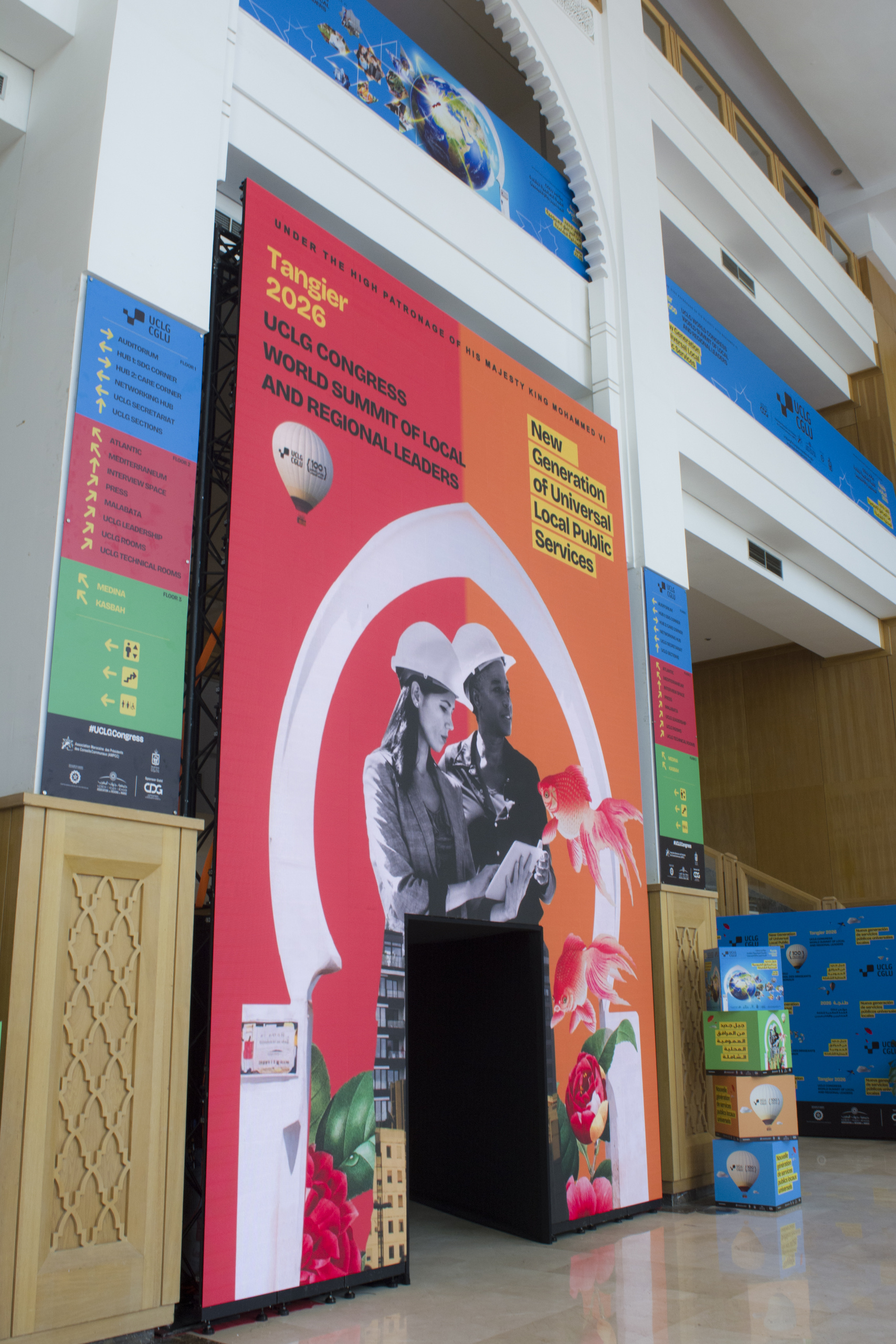
The Eighth Session of the World Summit of Local and Regional Leaders and UCLG World Congress officially opens today with one eye on the mandate that is ending and another one on the political cycle that begins in Tangier. Before the Official Opening Ceremony brings the Congress into public view this evening, UCLG’s governing bodies will meet in the Hybrid Tent for a day of institutional transition.
The Executive Bureau will open the statutory programme in the morning. Its agenda includes institutional affairs, policy highlights and strategic priorities, but one item will carry particular political weight: the dialogue on local public service provision and the launch of the Global Framework Agreement between UCLG and Public Services International.
That discussion goes to the heart of the Congress theme. A new generation of universal local public services cannot be built only through declarations. It depends on funding, public workers, social dialogue and the capacity of local institutions to respond to daily needs.
The General Assembly will take over in the afternoon. Its first task will be to review the Presidency Report for 2022–2026, closing the cycle that began in Daejeon with the Pact for the Future of Humanity and its three axes: People, Planet and Government. Under a rotating leadership model, UCLG has spent the past mandate advancing work on peace, care, feminist municipalism, climate justice, democratic resilience and renewed multilateralism.
The report also records several political openings for local and regional governments in the international system: Action 55(e) of the United Nations Pact for the Future, the UN Secretary-General’s Advisory Group on Local and Regional Governments, and the development of the Local Social Covenant that will frame much of the Tangier Congress. But the afternoon will not only look back. The first strategic debate, Local Multilateralism for Peace, will ask how the municipal movement should position itself in the post-2030 era. The session starts from a difficult premise: the values of the 2030 Agenda remain essential, but the multilateral system has not delivered them at the scale people need.
For UCLG, the answer is not less multilateralism. It is a different kind of multilateralism, rooted in proximity, public services, local democracy and territorial cooperation.
The debate will also bring forward We the Cities, a decalogue for the structural engagement of local and regional governments in the multilateral system. The objective is to move beyond occasional consultation and towards more permanent, differentiated and organised participation of local governments in global decision-making.
Peace will be treated not only as diplomacy or security, but as something built in territories: through dialogue, inclusion, rights, prevention, care and public services that hold communities together.
A second strategic debate, Coalitions for Local Innovation, will turn from political positioning to delivery. The discussion will explore how partnerships can help local and regional governments move from isolated experiments to implementation at scale. It will include the launch of the Global ScaleX Alliance for Cities between UCLG and UNIDO, alongside discussions linked to Cities Countdown to 2030, the Guangzhou International Award for Urban Innovation, the World Observatory on Subnational Government Finance and Investment, and contributions from the Town Halls on local finance and food systems.
The question behind the session is practical: if local governments are expected to respond to housing pressures, care needs, climate disruption, technological change and declining trust, what coalitions can help them deliver?
By the end of the day, the General Assembly will also address institutional affairs, including the electoral process and the appointment of the UCLG World Council for 2026–2029.
That gives the first official day of the Congress its shape. The morning starts with public services and the people who make them possible. The afternoon reviews the mandate born in Daejeon and opens the debate on peace, multilateralism and innovation after 2030. The evening places the Local Social Covenant in front of the full Congress.
Tangier begins where Daejeon left off, but the world has changed. The voice of the local and regional leaders is needed more than ever. Silence is not an option; neither is noise without direction. Tangier represents perhaps the most ambitious attempt in a decade to move local multilateralism to action, at a particularly challenging moment.
LOCAL MULTILATERALISM TAKES THE STAGE