

How local governments can solve problems together
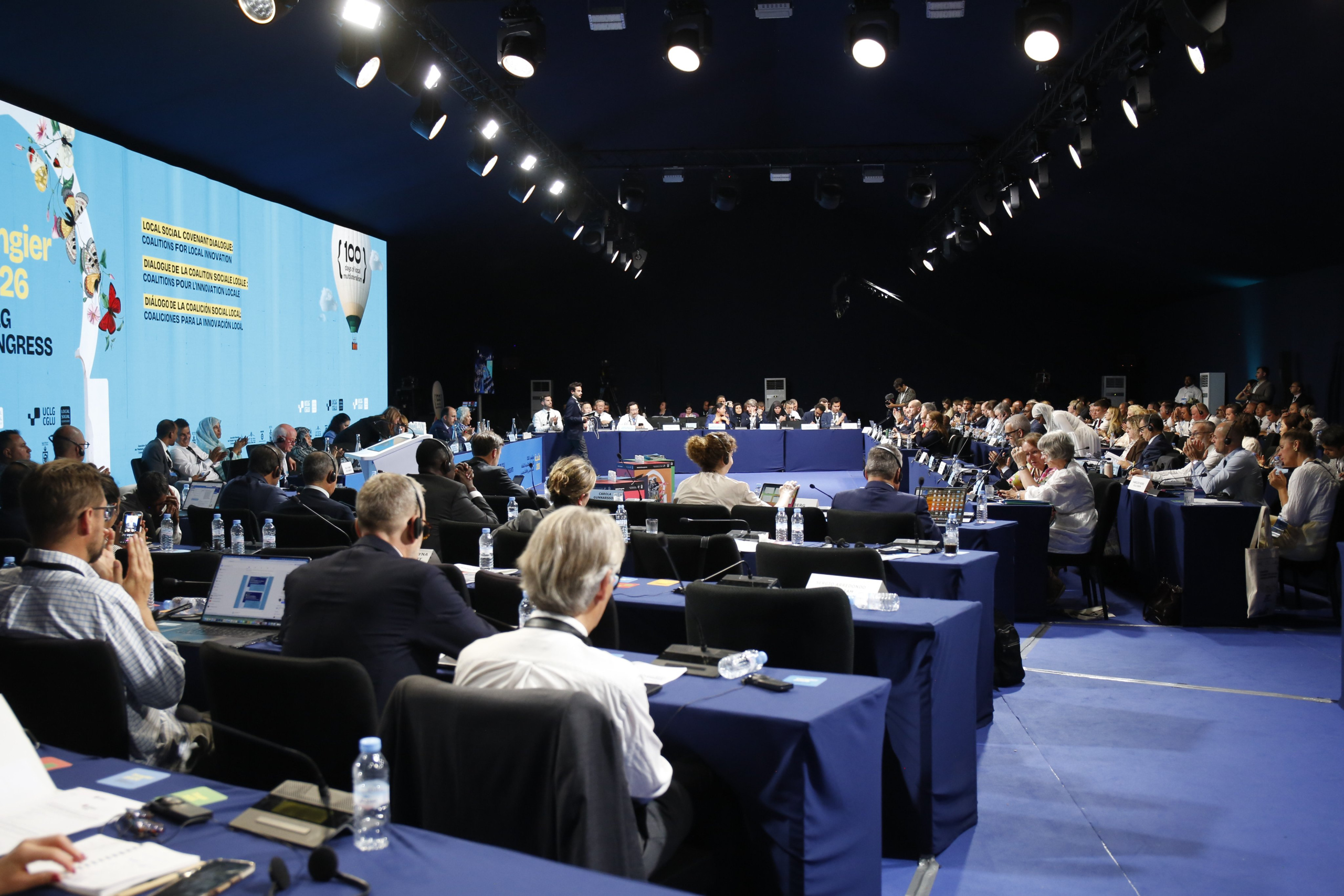
“We cannot solve the many challenges of local governments alone. We need to unite, get together, and overcome these problems with a more innovative, collaborative approach.” These were the opening remarks of Uğur İbrahim Altay, Mayor of Konya, during the afternoon’s session on coalitions for local innovation in the UCLG General Assembly. Participants discussed how local and regional governments can work with international organisations, innovation ecosystems, and development partners to accelerate solutions that respond to local priorities.
Yu-ning Hwang, Executive Director of the Centre for Liveable Cities of Singapore, recounted the recent World Cities Summit in Singapore and its “Act Now” theme. She emphasised that no single actor could solve problems like water resilience or the energy transitions: “None of us have all the knowledge, but we can come together and learn from each other.”
Sello Enoch Dada Morero, Mayor of Johannesburg, echoed these sentiments and added a financial perspective: “We have learned how finance institutions work in the last century. Now we must learn how to finance institutions, taking territories as the starting point for financial design.” Together with UCLG, the Global Fund for Cities Development (FMDV) has the core mission to localise finance for sustainable and climate-resilient urban development with the Finance Your Cities initiative, a great example for the mayor’s point. “We will turn risk into resilience. We will turn investment into dignity. We will turn innovation into shared prosperity.”
Adnan Seric, United Nations Industrial Development Organization (UNIDO) and Head of Innovation Lab, addressed the room by saying that the success of our common agenda, the SDGs, will depend on what happens in cities and territories. “Let’s translate innovation into investment and scale”, he said, mentioning UNIDO’s Bridge for Cities initiative as a global political and convening space. The Global ScaleX Alliance for Cities, part of this initiative, helps municipalities scale proven solutions for sustainable and inclusive urban development. Already, the first innovation scaling corridor is being tested in the Western Balkans, where cities like Podgorica, Sarajevo, Skopje and Tirana are joining forces to build greener, more competitive local industries and create better jobs for their citizens.
From the OECD, Aziza Akhmouch, Head of Urban Policies and Sustainable Development, reported that too many innovations remain at the pilot stage and do not grow enough. Conditions like place-based innovation, fiscal space, and the capacity for ideation must be met so that cities can be innovative. Together with UCLG and the World Observatory on Subnational Government Finance and Investment, her team has tracked data across 135 countries and has shown that subnational governments are responsible for 55% of public investment, while also facing growing f inancial pressure.
Agustí Fernández de Losada, Secretary for European and Multilateral Affairs and Development Cooperation of the Government of Catalonia, spoke more about the localisation of financing. He mentioned the Global Observatory on Subnational Finance as a valuable resource. “Take the pandemic as an example: from the local point of view, there was innovation to find solutions to this global crisis of huge dimensions. But without resources, it is impossible to promote and maintain efficient public policies.”
Frédéric Blanc, Representative of the French Ministry for Europe and Foreign Affairs, affirmed that the European Union acts as a partner that doesn’t believe in a divide between the Global North and the Global South. Similarly, Sébastien Vauzelle, Head of Local 2030 Coalition, pointed out how many different stakeholders are coming together in Bilbao as part of the Coalition, ranging from United Nations entities to national governments, local and regional governments, civil society organisations, academia, the private sector, and youth: “We are bringing together all these stakeholders to make systemic change happen.”
Claudia Juech from Bloomberg Philanthropies shared more practical insights on how cities can benefit from coalitions: “It starts with you – it starts with leadership.” She explained that coalition building requires city governments to be organised for that work, mapping actors around the problem, understanding what each one can contribute, and keeping the work moving when disagreements emerge. “That is not super glamourous and it’s not always visible work, but it’s most often the differences between the coalition members that truly produce results.”