

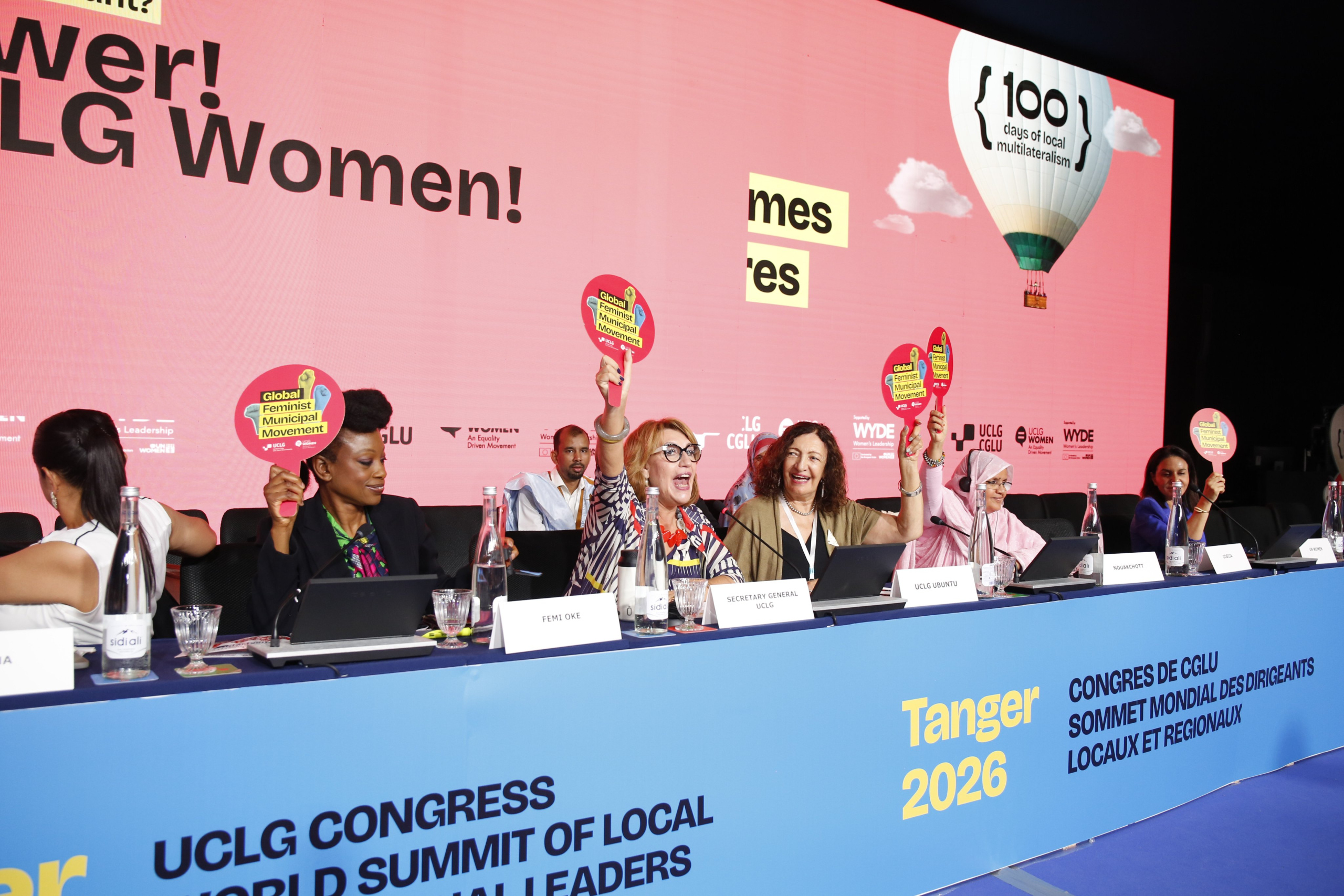
It took more than twenty years, eight World Congresses and countless women mayors, governors and local elected leaders for UCLG to hold its first Women’s Assembly.
The delay says as much as the achievement. Women are increasingly leading cities and regions around the world, yet they remain underrepresented in local political leadership, continue to encounter structural barriers to decision-making and are disproportionately exposed to harassment and political violence.
The first UCLG Women’s Assembly was a recognition that the future of local democracy cannot be built while half of its leadership continues to fight for equal space within it.
The symbolism extended to UCLG itself. Since the creation of the World Organization, only one woman has served as its President: Carolina Cosse, then Mayor of Montevideo, who assumed the rotating presidency for one year in 2023 following the Daejeon Congress. With UCLG’s leadership to be elected today, the session returned repeatedly to one question: would the result reflect the movement’s stated commitment to equality?
Convened under the banner “From representation to transformation” with support from the WYDE Women’s Leadership initiative, the Assembly brought women mayors, governors and councillors from every region into the statutory programme for the first time. It was built as an arc: an opening on feminist municipalism, a block on the movement’s legacy and the leaders it needs next, and a governance segment broken into six rapid pitches on women’s political participation, financing equality, ending violence, local care, climate justice, and inclusion.
While moderators Femi Oke and, later, Secretary General Emilia Saiz limited the 31 speakers’ interventions to a few minutes each to allow for a broad range of perspectives, demand for speaking time exceeded what the agenda could accommodate.
Fatimetou Abdel Malick, President of UCLG Women and of the Nouakchott Regional Council, opened by declaring that “another way of governing is already being born in our hands” — one that treats care as a central political force — and reminded the room that the body’s genderequality commission became permanent only “thanks to the struggle of African elected women.” Paola Pabón, the first woman to lead the Prefecture of Pichincha, described building a care system and twelve centres against gender-based violence, and announced her own bid to chair that commission.
The vote was a recurring theme. Carola Gunnarsson, Councillor of Sala, noted that the ballot for co-presidents offered only one woman — Fatiha El Moudni, Mayor of Rabat — among seven candidates, and that the presidency was being contested by a woman, Clara Brugada, Head of Government of Mexico City, and a man, Uğur İbrahim Altay, Mayor of Konya. Several speakers backed Brugada from the floor: Sharon Dijksma, Mayor of Utrecht, invoking Madeleine Albright’s line about “a special place in hell for women who do not support other women,” urged delegates to vote for Clara Brugada. Emilia Saiz returned the question to the World Council members present, saying the point was “not only about specific candidates” but “the presidency as a whole,” and that proposing a way to keep women in the enlarged presidency, whatever the result, was “not against the rules.” Ursula Sautter, Deputy Mayor of Bonn, asked why UCLG did not simply guarantee a double presidency that always includes a woman.
Myriem Ouchen Noussairi, Head of Office for UN Women in Morocco, set out the global picture. There can be “no inclusive democracy without women’s full, equal participation,” she said, citing UN WomenIPU figures: as of January 2026, only 30 women serve as heads of state or government, 27.5 per cent of parliamentarians are women, and just two countries have reached 50 per cent in local governments. Marking the Safe Cities initiative’s 15th anniversary, she invited Tangier to become its sixth Moroccan city to join, and called the new CEDAW General Recommendation No. 40 a parity roadmap for local governments.
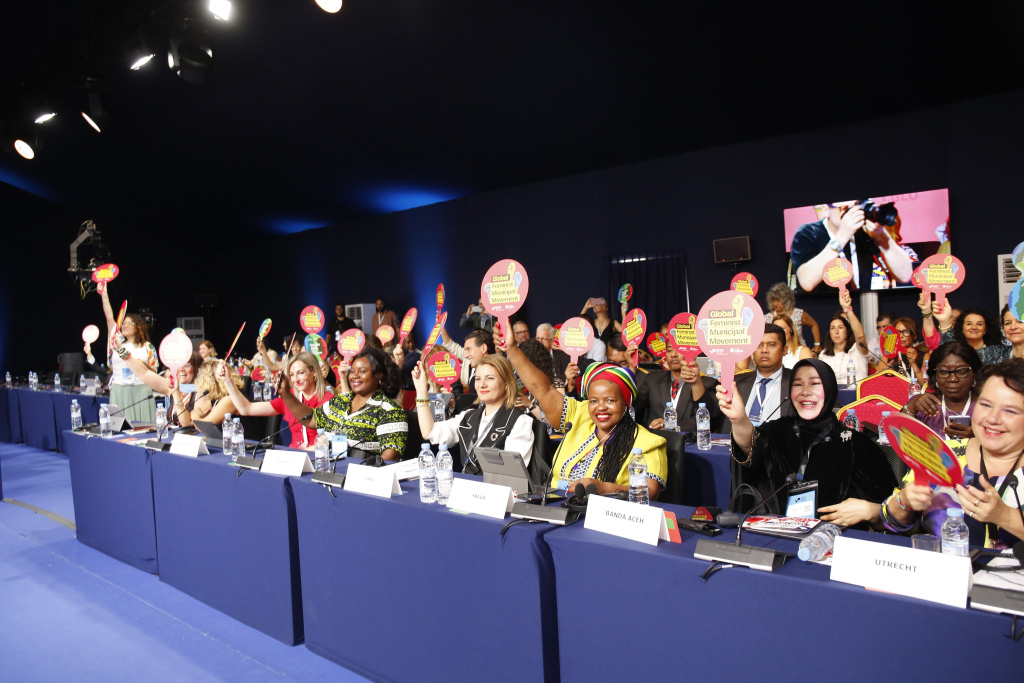
Opening the segment on the movement’s achievements, UCLG Ubuntu Advisor Ana Falú told the room, “This is the hour of women.” Rohey Malick Lowe, Mayor of Banjul, insisted that women in local politics “are not guests, we are architects,” adding that the legacy being built “is about the girl in Banjul who will never have to ask permission to lead.” Chioniso Michelle Murinda, of Zimbabwe’s Chegutu District Council, distilled the theme: “Representation without transformation is visibility without power.” Joining virtually, Célestine Ketcha Courtès, Cameroon’s Minister of Housing and Urban Development, noted that her country had reached 33 per cent women in Parliament but only 15 per cent locally, and pressed the room: “When we are asked to lead the lists, are we not afraid? Do we have the financial means?”
The governance block turned principles into demands. On participation, Milka Areba, President of REFELA-Kenya, called for five binding rules “with consequences”: enforceable parity, financing for women’s campaigns, training for the men who hold procedural power, and a rapid-response fund against political violence. “Let us stop asking for space. Let us govern now,” she said. On financing, Fatiha El Moudni, Mayor of Rabat, argued that “representation is just the beginning,” and that “sustainable financing is what transforms our commitments into realities.”
On violence, Kadhy Niang, Deputy Mayor of Dakar, set out four fronts: education, enforcement, support services and women’s economic autonomy, while Mayra Mendoza, Mayor of Quilmes, urged colleagues to “stop naturalising political violence.” Further, on care, Flora Maboa-Boltman, Deputy President of South Africa’s SALGA, argued “care is public infrastructure,” and Illiza Sa’aduddin Djamal, Mayor of Banda Aceh, noted that “care is a political act.”
Inclusion drew some of the sharpest voices. Patricia Morla, the first woman with a disability twice elected to municipal office in Villa Carlos Paz, said women like her must “stop being asked permission to exist; our experience is political.” Victoriia Mozgacheva, Deputy Mayor of Bishkek, said true inclusion “starts much earlier, with access to opportunities.” Sanjolli Padhy of the YP Foundation described a “deeply gendered polycrisis” and demanded resources reach grassroots actors directly: “Power must be shared.” From rural Colombia, Gil Milena Grueso Romero, the first woman mayor of Guapi, recalled facing 14 candidates, 11 of them men: “When we are united, no one stops us.”
Several speakers turned to the backlash. Clare Hart, Vice-President of Montpellier Méditerranée Métropole, warned of an online and offline “manosphere” driving real violence and called on male allies to “stand with us.” Lorena Elvira Ayuso, Catalonia’s Secretary-General for External Action and the European Union, warned that when women leave politics “the democratic quality of our institutions weakens,” and called for “more open institutions and safer spaces.”
In the closing, the topic returned to the vote. Nadine Gasman, Mexico City’s secretary for citizen security, called electing a woman president “a historic opportunity”; the newly elected continental REFELA president, Meyanga Marie Angèle, hoped the two women candidates might yet come together behind “a consensus candidate, to show the world we are united.” Emilia Saiz closed where she had begun: whatever presidency emerges tomorrow, “it needs to be a presidency that supports equality.” The Assembly’s next step is institutional: a permanent UCLG Women’s Council, a standing political home for feminist municipalism beyond Tangier.