

WHY TANGIER IS AT THE HEART OF GLOBAL GOVERNANCE
Local governments are on the front lines. They are the first to receive complaints when the bus does not arrive, when housing becomes unaffordable, or when heatwaves, floods or fires move from climate models into streets, schools and emergency rooms. They are the first to navigate the daily negotiation between what communities need and what institutions can actually deliver.
This is what makes mayors, governors and local leaders politically different. They govern from close at hand rather than from afar, and they make an impact where politics becomes visible.
Local and regional governments have never seen themselves merely as implementers of decisions made elsewhere. They raise taxes, manage budgets, deliver services, regulate territory, convene communities, respond to emergencies, negotiate with citizens, and make political choices every day. From their point of view, the argument that they “matter” was settled long ago by the act of governing itself.
Multilateral institutions and national political systems have often treated local and regional governments as delivery arms rather than as political actors, and therein lies the problem.
They are asked to implement agendas they did not fully shape, absorb pressures they did not create, or respond to crises with powers and resources that rarely match the scale of expectation. That mismatch has become one of the central questions of contemporary governance.
A survey of OECD countries shows that trust in public institutions remains fragile. Government at a Glance 2025 reports that 39 per cent of people express high or moderately high trust in their national government, while 44 per cent report low or no trust. Local government performs better, at 45 per cent, the same level as the civil service and above national parliaments, which stand at 37 per cent. The OECD also points to a deeper issue: political agency. Among people who feel they have a voice in government decisions, 69 per cent report high or moderately high trust in national government; among those who feel they lack a voice, the figure falls to 22 per cent.
These figures do not suggest that local governments are immune from distrust. Proximity does not automatically produce legitimacy. In fact, sometimes it produces the opposite: residents know exactly where to direct anger when services fail, neighbourhoods change or public promises remain unmet. But the data help explain why local democracy remains so politically important: the closer institutions are to daily life, the more they depend on participation, responsiveness and the feeling that people can shape decisions that affect them. This is where many of the defining political battles of the next decade will be fought.
Housing is no longer only an urban planning issue; we are talking about security, inequality, displacement and belonging. Climate change is no longer only a diplomatic file. It is drainage, shade, heat, water and public budgets. Migration is not only border policy; it is schooling, housing, work and local inclusion. And care is not only a private matter. It is time, labour, gender justice and social organisation.
Public services sit at the centre of this shift. They are where the promise of government becomes measurable. A service either arrives or it does not. A neighbourhood is connected or it is not. A child has a place to learn, an older person has support, a family has water, a woman has safe transport, a young person has somewhere to participate — or they do not.
The debate on a new generation of universal local public services is therefore political rather than technical. It asks what communities should be able to expect from public institutions in a period of climate instability, social fragmentation, demographic change and democratic uncertainty. It also explains why the current backlash against pluralism, equality and rights matters so deeply for the municipal movement.
Local democracy is not only about administration. It is about how communities define who belongs, whose needs are visible, who is safe in public space, who is heard, and which forms of solidarity remain possible.
The values of the municipal movement have always been rooted in the idea of community — a concept that is not neutral. It can be used to include as well as exclude, to protect or police, to open institutions or close them. In the coming years, local and regional governments will not only be judged by whether they deliver services, but also by what kind of public life they defend.
UCLG enters this debate with a particular history. Created in 2004 through the unification of the International Union of Local Authorities (IULA) and the World Federation of United Cities (FMCU), it has tried to give form to a claim that is simple in principle but difficult in practice: local and regional governments are part of governance, not outside it.
They localise decisions and thereby govern societies. This is what makes UCLG complex, as well as significant.
The push for the inclusion of local and regional governments became particularly visible during the negotiations around the Sustainable Development Goals and the New Urban Agenda. Through the Global Taskforce of Local and Regional Governments, the municipal movement worked to ensure that local and regional authorities were recognised in global agendas not as decorative partners, but as necessary actors. In 2016, the New Urban Agenda recognised the World Assembly of Local and Regional Governments in its follow-up and review process.
While this recognition was an important step, it did not solve the problem. The multilateral system remains overwhelmingly state-centred. National governments still decide the formal rules of global negotiation. Local and regional governments may be invited, consulted, showcased or acknowledged, but they are not yet structurally embedded in the way global decisions are made.
The United Nations has moved in recent years, including through the Secretary-General’s Advisory Group on Local and Regional Governments. The initiative signalled that the UN system understands the gap, but it still remains.
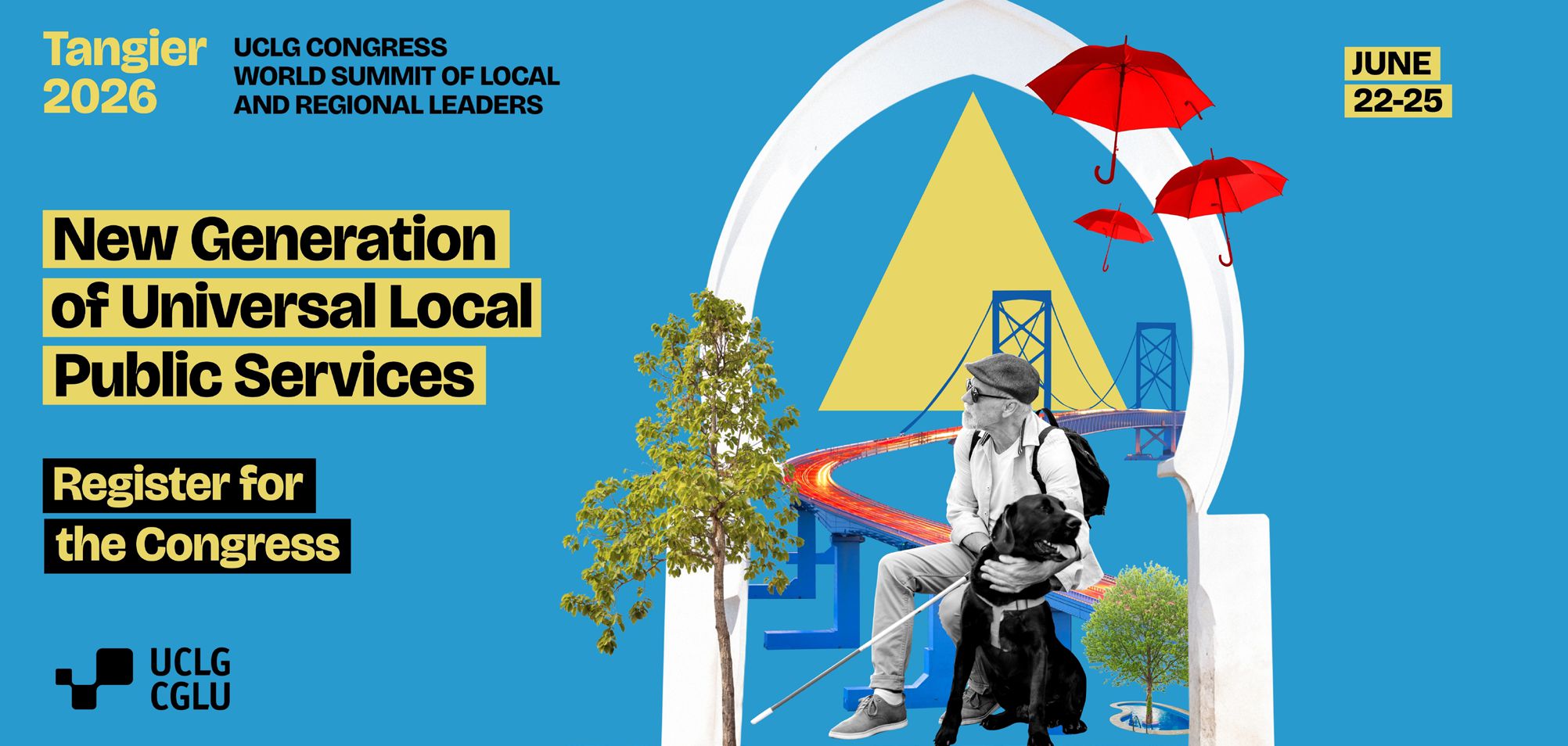
This is the political context in which the UCLG World Congress and World Summit of Local and Regional Leaders will take place in Tangier.
Local governments have wanted to influence global affairs for decades. As the gap between what local and regional governments are asked to do and how little they currently shape the systems around them is becoming harder to ignore, Tangier arrives at a crucial time.
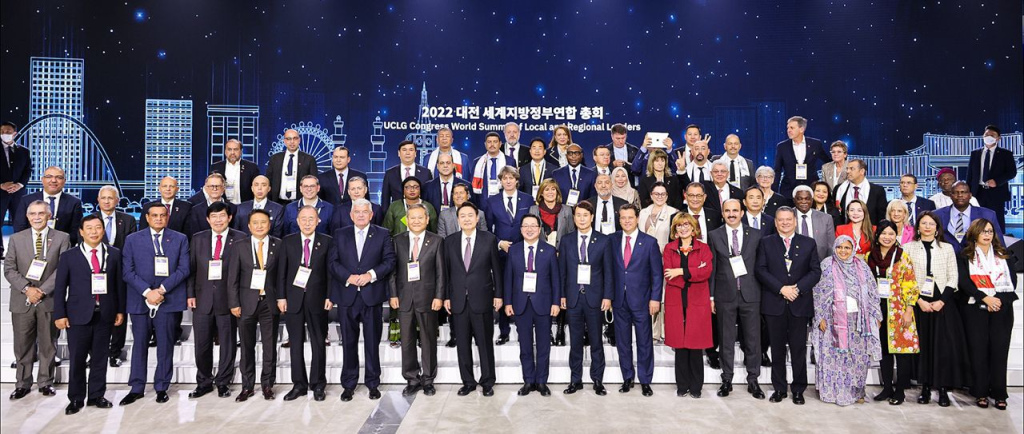
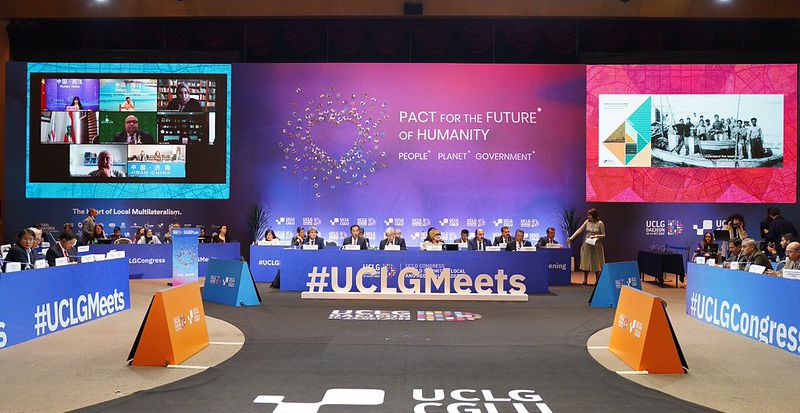
It comes ten years after the adoption of the New Urban Agenda. It follows the Pact for the Future adopted by UCLG in Daejeon in 2022. It takes place after the United Nations adopted its own Pact for the Future in 2024. It sits inside the 100 Days of Local Multilateralism, a sequence connecting the World Urban Forum, the UCLG World Congress, the High-Level Political Forum and the review of SDG 11, as well as the ten-year review of the implementation of the New Urban Agenda. And it looks ahead to the post-2030 debate, where the next global development agenda will begin to take shape.
In Tangier, UCLG will also elect its leadership for the next cycle and is expected to approve the Local Social Covenant. That combination — leadership renewal, a new political framework and the post-2030 horizon — is what gives the Congress its weight.
The Pact for the Future gave the municipal movement a shared horizon built around care, the planet and government. The Local Social Covenant tries to move that discussion into a more concrete phase.
Prepared through a process involving elected leaders, organised civil society, UCLG Policy Councils and the Town Hall, the Covenant addresses housing, local finance, public health, food systems, conflict prevention, climate justice, culture and new essentials, with care, anti-racism and youth running across the process.
The Covenant is being shaped through dialogue with civil society partners, public service actors, thematic networks and local leaders. It reflects UCLG’s ambition to make the municipal movement a space where diverse voices enter political debate, even when the concepts are complex and the achievements are difficult to translate into simple headlines.
Much of the municipal movement’s work happens far from public view. A mayor responding to a flood is easy to understand. A local government network trying to influence the design of the post-2030 agenda is harder to communicate.
The architecture matters because it shapes whether local governments will have the mandate, finance and recognition to respond when crises arrive.
The same is true of political representation, which has often been an entry point for women’s political participation, but is also a place where inequality, violence and exclusion remain visible. Within UCLG, the feminist municipal movement has gained stronger political space. The Congress in Tangier will include the first UCLG Women Assembly, bringing together women mayors, governors and local leaders to advance equality, leadership and feminist municipalism.
A movement that speaks about care, public services, anti-racism, youth participation and everyday essentials cannot treat equality as an add-on. It has to ask who governs, whose experience shapes policy, whose safety is protected, and whose labour is recognised.
Tangier will not answer all these questions, but it will bring them into the same political space: statutory meetings, regional assemblies, Town Hall processes, Local4Action sessions, public service workers, the Tangier-Morocco Track, civil society partners, women leaders, youth engagement, housing justice, care, finance, climate, culture and post-2030.
This defining feature of a coalition of coalition makes the Congress politically interesting and highly relevant. Beyond discussing global challenges, participants will try to define a collective voice before the next global agenda is written.
So, the question is not whether local and regional governments matter. They already govern. The question is whether the systems around them — national, regional and multilateral — are ready to treat them accordingly.