

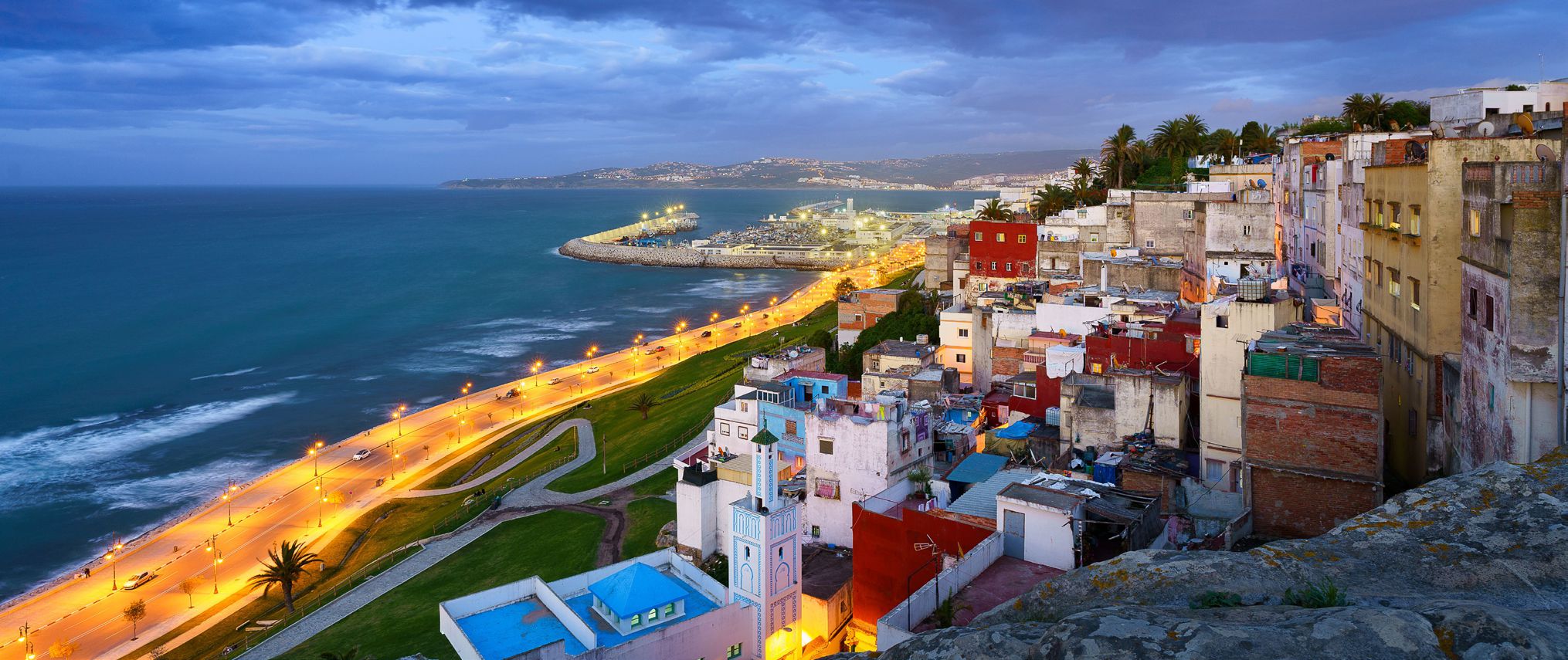
Tangier has a habit of becoming whatever history asks of it.
A gateway, a refuge, an artists’ sanctuary, an industrial powerhouse… Few cities have changed identities so many times without ever losing their own.
From the terrace cafés overlooking the Strait of Gibraltar, Europe appears deceptively close. Proximity has always been Tangier’s business; for centuries, the city has occupied a narrow strip of geography where continents, languages and cultures meet. The result is a city that rarely sits still.
Tangier’s told through movement: people arriving, leaving, trading, working, returning and imagining new lives across the Strait. Beyond a place of passage, Tangier is a city where local identities, languages, economies and everyday practices have continually adapted without disappearing.
Unlike many historic port cities that might have been tempted to live on memory alone, Tangier has undergone one of the most significant urban and economic transformations in the Mediterranean over the past two decades. One of the driving forces behind this has been the arrival of Tanger Med, which changed the landscape.
What was once a city looking towards its past became a city looking decisively towards the future. The port complex transformed northern Morocco into a strategic logistics and industrial hub. With it, new industries arrived, infrastructure expanded and investment followed.
Yet the old Tangier remains stubbornly present. Walk through the Medina in the early morning and traders still open shops beneath centuries-old walls. In the Grand Socco, conversations drift between Arabic, French, Spanish and Darija. Families gather on the seafront promenade in the evening. Young people claim public space with an ease that feels distinctly Mediterranean. This coexistence of old and new may be Tangier’s defining characteristic.
The city has never chosen between heritage and transformation because it has learned to live with both, and that balancing act is visible across the urban landscape. Historic neighbourhoods overlook new districts, traditional markets coexist with modern logistics platforms, and international investment meets deeply local identities.
Cities often speak about resilience, but Tangier embodies this concept through its history of continuous negotiation with change. Many of the questions shaping urban debates today are questions Tangier has been confronting for decades:
How do cities remain open without losing their identity? How do they benefit from globalisation without becoming dependent on it? How do they embrace transformation while preserving a sense of place?
Visitors will find different answers depending on where they look: in the Medina, on the waterfront, in cultural spaces, or in the debates taking place throughout the Congress.
The best way to understand Tangier may not be to read about it. It may be to explore it — and join the conversations that the city is hosting this week.