

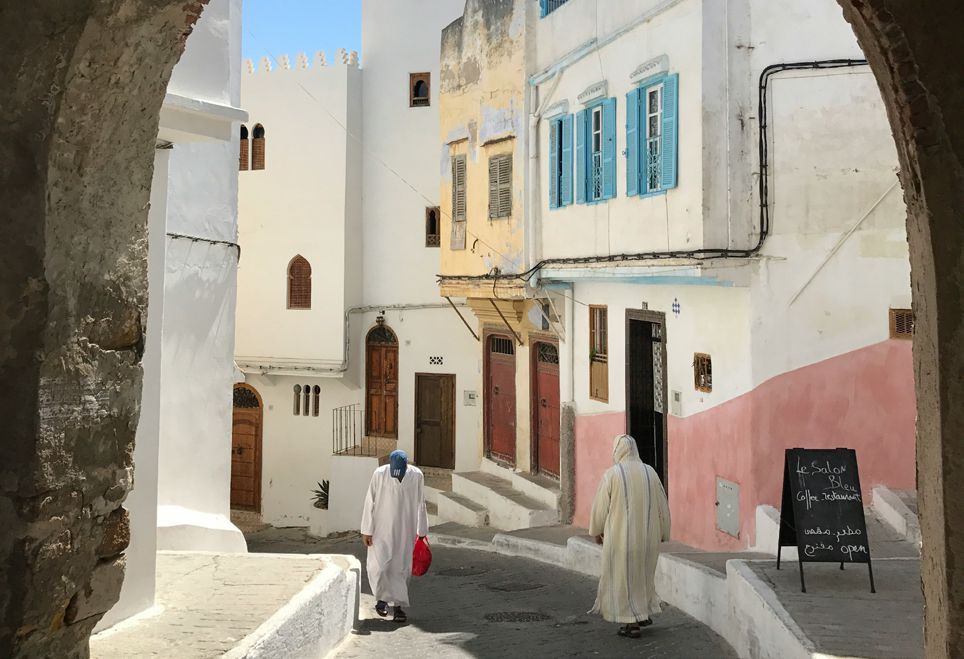
Tangier: Reinvention at the Edge of the World
Distance: 4 km walking route
Duration: Half day
Starting point: Palais des Arts
Ending point: Kasbah overlooking the Strait
Most visitors discover Tangier through its history. This walk explores the city through seven places that reveal how Tangier is reinventing itself today: through culture, public space, care, heritage and territorial transformation.
Stop 1
Palais des Arts –
The new civic stage
The Congress begins here. Located along Tangier’s expanding waterfront, the Palais des Arts reflects a city increasingly positioning itself as a cultural and international hub. More than a venue, it symbolises a city investing in civic and cultural life alongside economic growth. Before heading towards the Medina, take a moment to observe the surroundings.
Look for: the contrast between the modern waterfront and the historic city rising above it.
Address: Tangier Waterfront District
Stop 2
The Corniche and Marina –
Tangier turns back towards the sea
Like many port cities, Tangier once turned its back on the waterfront. Today, the Marina and Corniche have reconnected the city with the sea, creating one of its most vibrant public spaces. Families, runners, visitors and residents share the same promenade, particularly at sunset. The success of the project lies less in the architecture than in the life it attracts.
Question to take with you: Who is public space designed for?
Location: Avenue Mohammed VI, Marina Bay
Stop 3
Think Tanger Kiosk –
The city as a conversation
Founded as a civic innovation platform, Think Tanger has become one of the city’s most interesting spaces for reflecting on urban change, public participation and sustainable development. Through research, exhibitions, debates and community engagement, it encourages residents to think critically about the future of their city. For visitors, Think Tanger offers a different perspective on Tangier.
Question to consider: Who gets to imagine the future of the city?
Address: 14 Rue Khalid Ibn El Oualid
Stop 4
Cinema Rif and the Grand Socco –
Culture as urban infrastructure
At the edge of the Medina, facing the Grand Socco, stands Cinema Rif — one of Tangier’s most beloved cultural institutions. Facing the Grand Socco, Cinema Rif is one of Tangier’s most important cultural institutions. More than a cinema, it is a gathering space, a platform for dialogue and a symbol of the city’s contemporary creative scene. Around it, one of Tangier’s busiest public squares continues to bring together residents, artists, students and visitors. This place proves that cities need cultural as much as physical infrastructure.
Look for: how different communities occupy and share the same space.
Address: Place du 9 Avril 1947 (Grand Socco)
Stop 5
The Medina –
Adaptation as an urban strategy
The most remarkable thing about Tangier’s Medina is not its age. It is its ability to adapt. For centuries, the district has absorbed new residents, new economies and new visitors while maintaining a strong sense of identity. The Medina is not a preserved relic; it is a living neighbourhood. Many cities speak about resilience. Tangier’s historic core demonstrates that resilience often comes through adaptation.
Look for: local commerce, workshops and everyday life thriving alongside tourism.
Access: Enter from Grand Socco and continue towards the Kasbah.
Stop 6
Association DARNA –
Where care becomes visible
Founded in 1995, DARNA works with women and young people through education, vocational training and social inclusion programmes. For visitors interested in the growing prominence of care in urban policy, this is an opportunity to see what the concept looks like beyond strategies and declarations. Here, care becomes opportunity, skills and participation.
Question to consider: What would happen if cities measured care as seriously as they measure infrastructure?
Address: 9 Rue du Détroit, Marshan
Stop 7
The Kasbah –
Looking in every direction
Finish the walk at the Kasbah. From here, Tangier reveals itself all at once: the Strait, the port, the Medina, Europe, the Atlantic and the Mediterranean. Old and new. Local and global. Past and future. Few viewpoints explain the city more clearly. Tangier’s history has never been about choosing between identities. It has been about connecting them.
Address: Place de la Kasbah
Optional Excursion
Tanger Med
If the Kasbah explains Tangier’s past, Tanger Med explains its future. Located around 40 kilometres east of the city, the port complex has transformed northern Morocco into one of Africa’s most significant logistics and industrial hubs. Its impact extends well beyond shipping, influencing employment, investment, infrastructure and regional development. For delegates interested in territorial transformation, few places illustrate the power of infrastructure, connectivity and long-term planning more convincingly.
Location: Ksar Sghir, approximately 40 km east of Tangier