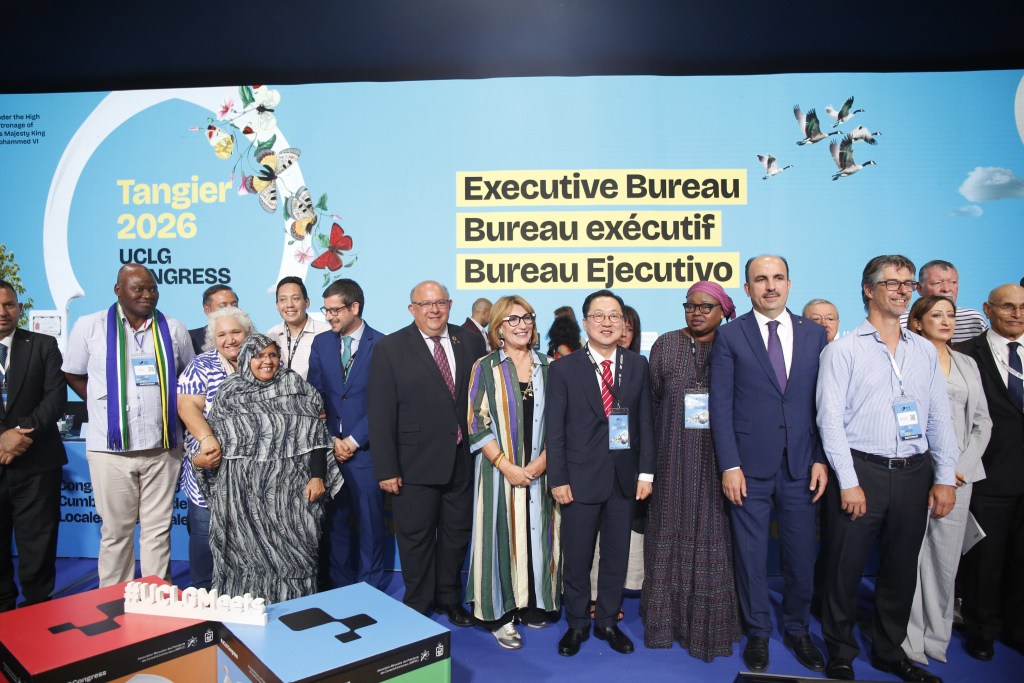
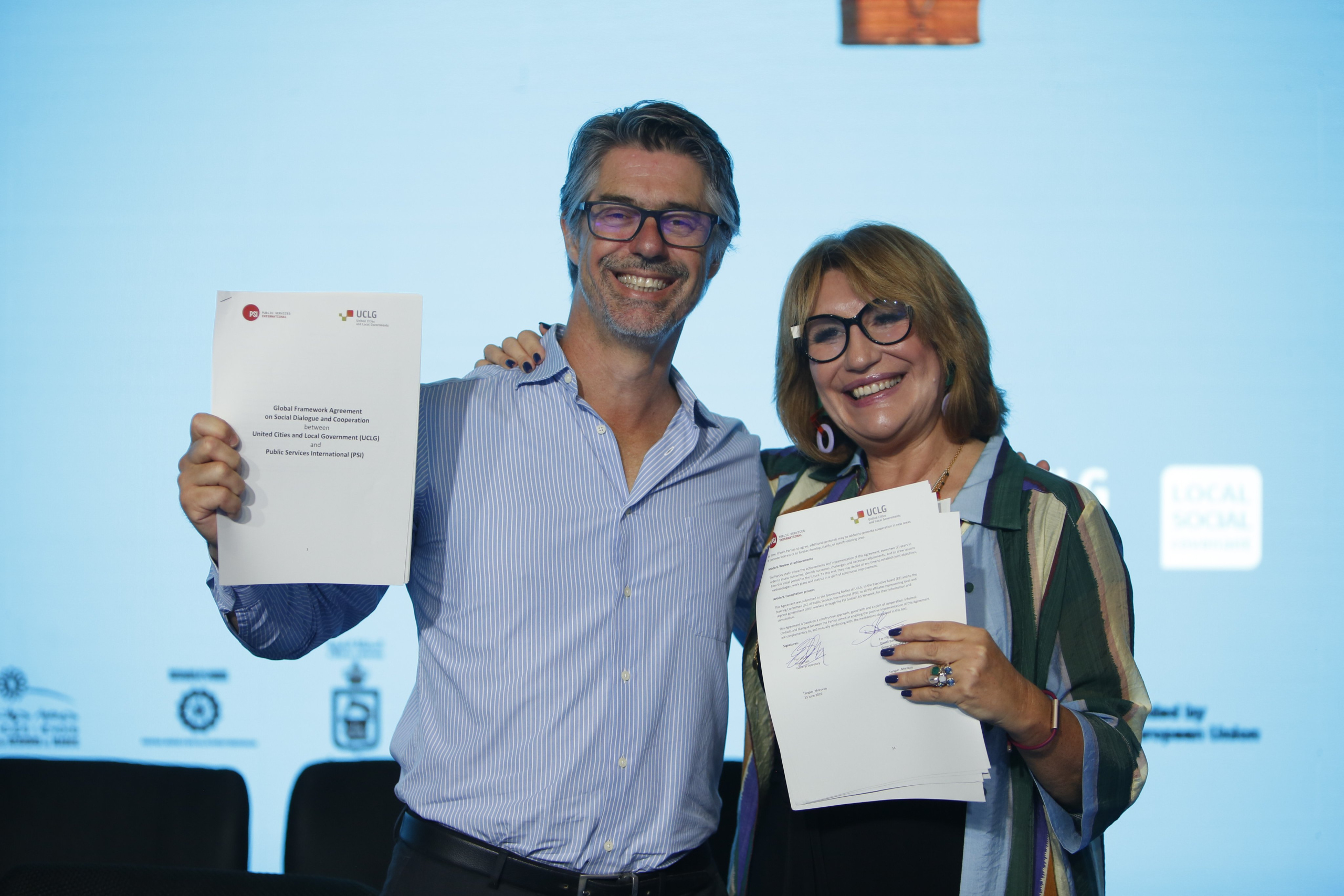
On the International Day of Public Service, the UCLG Executive Bureau opened the statutory programme of the Tangier Congress not with procedure, but with a signature. Meeting in the Hybrid Tent, local and regional government leaders and trade union representatives witnessed the launch of the Global Framework Agreement on Social Dialogue and Cooperation between UCLG and Public Services International (PSI), which is a structured space for dialogue that, in the words of the signatories, had been missing from the international architecture for more than a century.
Chairing the session, Berry Vrbanovic, Mayor of Kitchener, framed the day as the right way to begin a Congress devoted to a new generation of local public services, noting that he had started his own career on the staff side before being elected.
Daniel Bertossa, Secretary General of PSI, called the moment a homecoming and a milestone. He warned that years of austerity, under-investment and privatisation had weakened local services in many countries, with consequences far beyond service delivery. “When public services deteriorate, trust in public institutions declines,” he said, arguing that social dialogue is not an obstacle to change but one of the conditions for its success. There can be no universal access to public services, he added, without decent work for the people who provide them.
UCLG Secretary General Emilia Saiz was candid that the partnership would not be a simple one, describing a complex relationship that touches both labour rights and the daily lives of people everywhere. The advantage, she said, lay in a long history of working side by side, from water and housing to migration. Recalling the COVID-19 pandemic as a point of inflection, she called for new missions for everyday life and a different f inancial architecture to deliver them. “Let us hope that public becomes the new trend,” she told participants.
The dialogue that followed gave the floor to mayors and workers in turn. Rohey Malick Lowe, Mayor of Banjul, spoke of public services as the front lines of dignity, insisting that strong cities are impossible without decent work and a seat at the table for those who deliver it. Marta Prates, Mayor of Reguengos de Monsaraz, brought a rural Portuguese perspective, warning that people can be excluded not for who they are but for where they live, and describing public services as the way democracy becomes visible in daily life.
Fernando Gray, Mayor of Esteban Echeverría and UCLG Vice-President for Latin America, placed workers at the centre as the backbone of public services, calling for governance focused on wellbeing rather than algorithms. From Spain, Jordi Castellana of the Barcelona Metropolitan Area argued that without good public services, societies become more unequal and polarised, and less resilient against authoritarianism. Strong services, he said, depend on decent work and social dialogue with trade unions. He illustrated this point through metropolitan policies on social transport tariffs, inclusive economic development, and accessible digital services. Cristian Zamora, Mayor of Cuenca, recounted how his municipality built hospitals it was not formally responsible for, treating 20,000 people in three months where the national health system had faltered.
Union voices reinforced the message. Annie Enriquez Geron, of the Philippines, anchored the agreement in transparency, accountability, and participation as the foundations of good governance. Steve Joseph, of the Dominica Public Service Union, recalled the climate disasters that make decent work a matter of survival in small island states. Nadia Koubia, government employment and union representative in the host country, described frontline staff as the face of local government, while Rebecca Céspedes, of the Global Network of Local Government Workers, noted it had taken ten years of dialogue to reach this day, pointing to remunicipalised waste collection in San José as proof that public delivery can outperform the private alternative.
Closing the dialogue, Philippe Malaise of the Fédération Interco CFDT ikened the agreement to a gem with many facets: the recognition of public service workers, a tool for meeting climate and resource challenges, and an affirmation of multilateralism at a moment when many heads of state are questioning it. Reached only through compromise, he said, it was a first stone rather than an end.
Anthony Berthelot, representing Nantes Métropole, said the city was proud to have contributed to the agreement, framing it as a shared vision of democracy, human rights, gender equality, and protection of the planet. Defending workers means defending public services, he argued, and with funding a persistent challenge, cities needed a place at the decision-making table.
The open floor sharpened the tone. Paola Pabón, of Ecuador, framed the choice as an ideological one between two models: one that defends the public sphere and one that erodes it for private gain. She cited the dismissal of 5,000 public servants in Ecuador in 2025 and called for services built around women’s needs. Dante Velázquez, Mayor of La Quiaca, described roads left unmaintained after fuel-tax revenue stopped reaching municipalities, while Andreas Wolter of Cologne and the Costa Rican delegation offered the counterpoint of federal systems and remunicipalisation, where public delivery has held firm.
The session’s most striking words came from Abdel Karim Al Zubaydah, President of the Association of Palestinian Local Authorities: “The only form of equality a Palestinian citizen gets is, actually, death. Everyone is equal in death”
The signing is, by every account, a first step rather than a destination. Its success, as Bertossa put it, will depend on the leaders and workers in the room using it, owning it, and filling it with meaningful action. In Tangier, that work has now formally begun.