

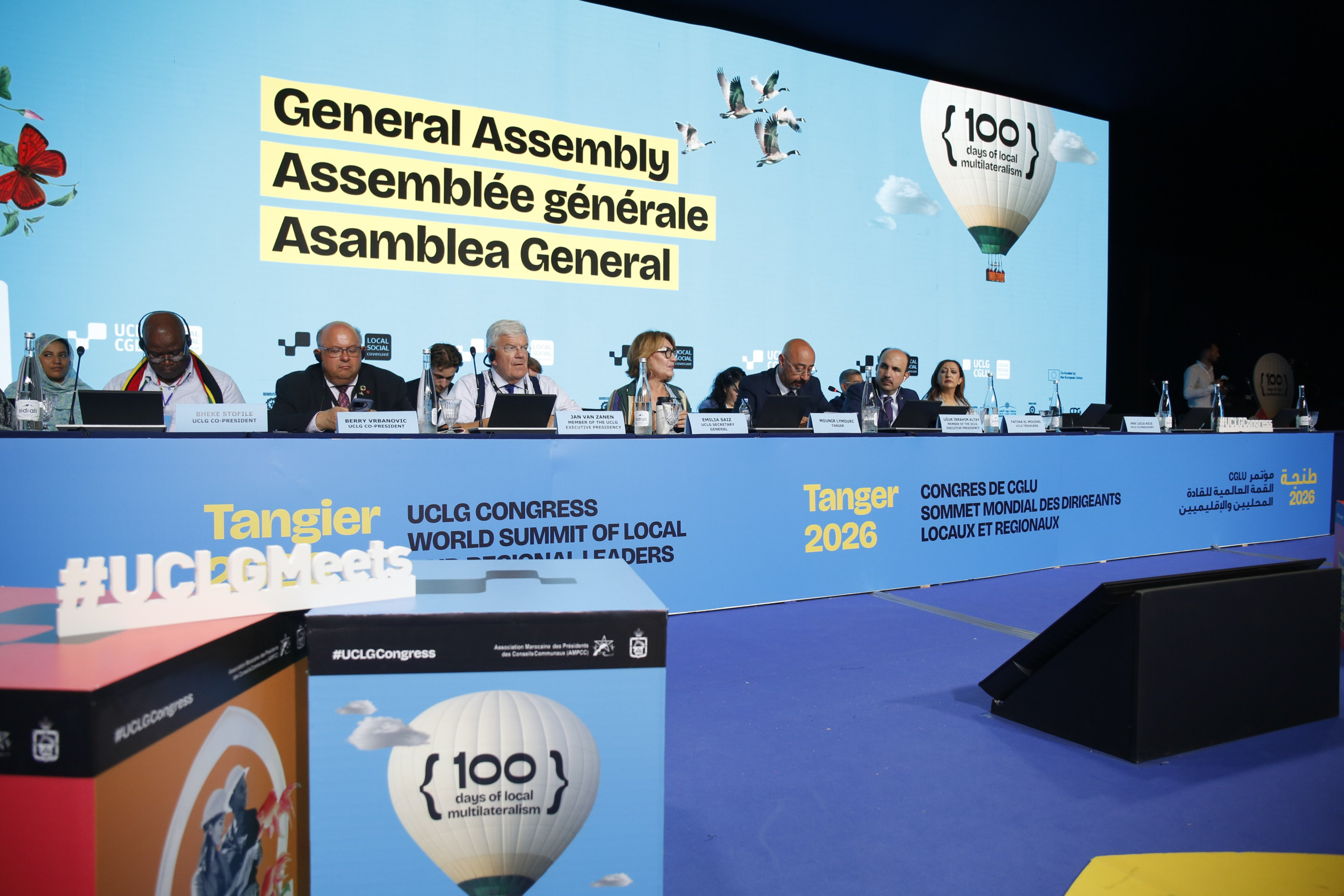
UCLG General Assembly became yesterday the political stage where local and regional leaders looked beyond the current mandate and towards the post-2030 agenda.
After the presentation of the Presidency Report for 2022–2026, the Assembly turned to the Local Social Covenant dialogue on the post-2030 strategy and local multilateralism for peace. The debate placed one question at the centre: how can the municipal movement help shape the next global agenda while ensuring that peace, care, public services and dignity are rooted in people’s daily lives?
“We are not here just to reflect, we are here to act” – this statement by Emilia Saiz, UCLG’s Secretary-General, guided the discussion.
Mounir Laymouri, Mayor of Tangier, emphasised the importance of committing to democracy and peace, inviting participants to build common memories in the host city. “In Daejeon, we adopted the Pact for the Future of Humanity”, Uğur İbrahim Altay, Mayor of Konya, pointed out. “These convictions have guided our work, as you can see in the report on the UCLG Presidency 2022-2026. We must ensure that we speak with one voice that reflects the differences in the variety of our geographies. The true test will not be the promises we make, but whether people can live with dignity in the places they call home.”
For the post-2030 Agenda, it will be key to look beyond the implementation of current goals and consider how to further support universal local public services through the Local Social Covenant, placing care at the heart of our work. “Our movement has been guided by the simple but powerful conviction that our agenda can only thrive when people feel connected and respected”, Jan van Zanen, mayor of The Hague, stated. “The question of peace has become impossible to ignore. For local governments, peace begins much closer to home, with public life. When people have access to public services, healthcare, culture, education, when they embrace diversity rather than fear, when communities trust their institutions and when public spaces become places of encounter rather than of division, then we have peace.”
This perspective of local governments as peacebuilders that do not only rely on the absence of violence, but on the presence of rights, dignity, belonging, and hope, was present in all speakers. “We need proximity, dialogue and trust – this is something that local multilateralism offers and this is why it matters”, van Zanen added.
Bringing the realities of communities into global decision-making is key to supporting peace and is something that all speakers see for the post-2030 Agenda. “We have a clear message: Local governments are ready to become partners”, Fatimetou Abdel Malick, President of Nouakchott (Mauritania) and co-chair of the United Nations Secretary General’s Advisory Group on Local and Regional Governments, said when talking about the planned United Nations reforms and the post-2030 Agenda.
“The future is local, and this space for local multilateralism is crucial. After all, societies are built from the ground up through inclusive, community-centred action. We believe that solutions must be rooted in justice, equity, and human rights”, Binaifer Nowrojee, President of Open Society Foundations, added, explaining that effective public safety depends on the trust between communities and the institutions that are meant to serve them.
The “Leave no one behind” principle of the 2030 Agenda is something that all participants want to carry beyond the year 2030 – after all, it is more important now than ever before. David Perejil, Director General for the 2030 Agenda for the Spanish Government, introduced the country’s new sustainable development roadmap that shows what the time after 2030 could look like. Housing and feminist care already play a key role in that agenda.
Paula Gaviria Betancur, United Nations Special Rapporteur on the Human Rights of Internally Displaced Persons (IDPs), explained that over 82 million (almost the population of Germany) people worldwide are internally displaced. “This is a global crisis, but also a local reality. IDPs are, first and foremost, residents in your cities. Displacement is not just a crisis to manage but also an opportunity to strengthen civil society, spur innovation, and increase resilience. This is a chance to treat care as a public responsibility, embedded in policy, planning, and service delivery.”
Paola Pabón, President of Pichincha, affirmed this point, especially given the realities of climate change and armed conflicts all over the world. “I think that the lack of care is a form of violence too. We cannot achieve lasting peace when we destroy the common goods that define public life.”
Commenting on the statements, Utrecht’s mayor Sharon Dijksma was struck by the willingness of the group to reflect on how multilateralism itself needs to evolve. “The real test for a post-2030 Agenda will not be whether we can agree on a new framework, but whether international collaboration and multilateralism will become more successful in improving people’s lives, from finding a home to participating equally and safely in society as women or girls. Let’s make delivery our starting point.”
Lucy Slack, Secretary-General, Commonwealth Local Government Forum, said: “We are one of the organisations that still has hope and faith. We are still here, and we believe in this work. Local government is at the heart of the delivery of services. That contract between local government and society is really what we are about here, and we need to build trust.” people’s lives, from finding a home to participating equally and safely in society as women or girls. Let’s make delivery our starting point.”
On today’s World Day of Public Services, this is perhaps the key message of the second conference day in Tangier. Gino van Begin from ICLEI, summed this up by saying: “Public service is an act of faith in public life, and this act of faith matters now more than ever.”
Alongside the statutory meetings, representatives from Africa, Europe and Asia-Pacific met on the margins of the Congress to discuss regional priorities and align regional perspectives ahead of the World Council and the political discussions that will continue throughout the Congress. The assemblies remain one of the main channels through which the diversity of the UCLG membership feeds into the political agenda of the World Organization.