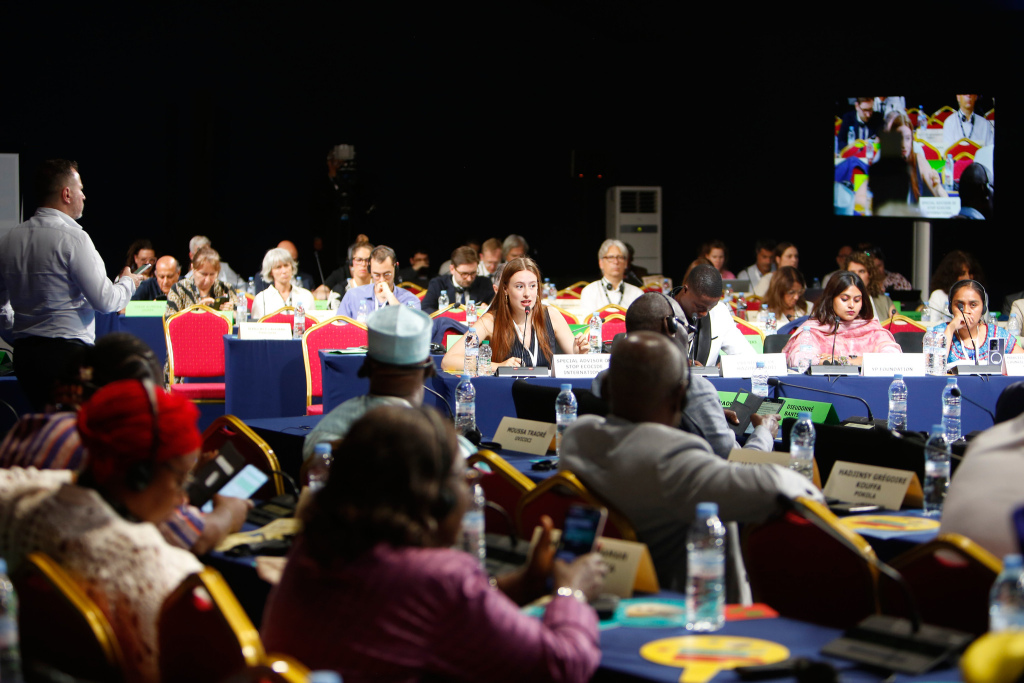
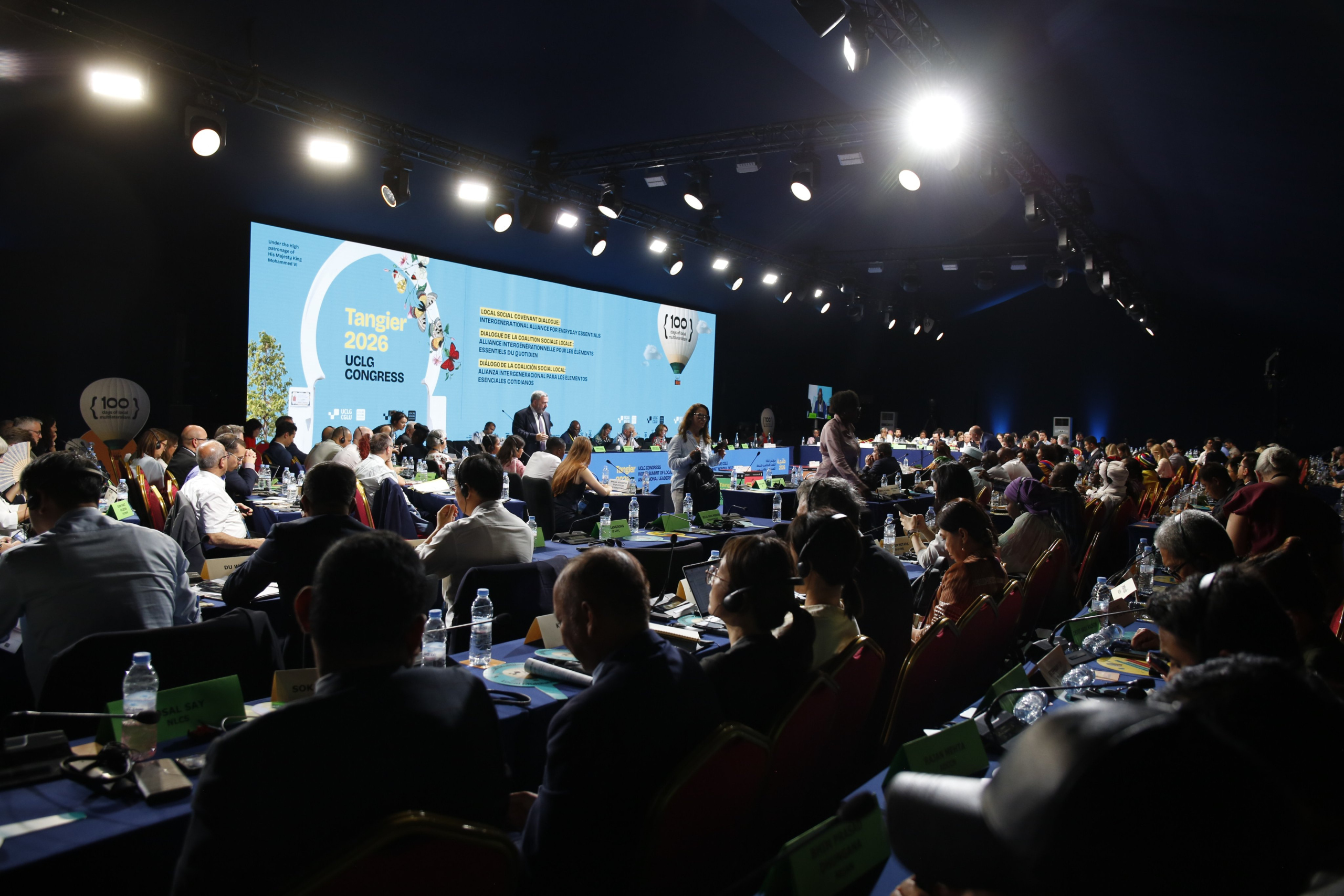
How can we redefine access to essential services and rights not only as matters of service provision, but as collective political commitments rooted in equality, dignity, and inclusion? This question guided yesterday afternoon’s discussion in the tent. Importantly, the Intergenerational Alliance on Everyday Essentials, unanimously adopted by delegates, will look at how people of different ages can shape their future together. “Co-creation with civil society is not optional”, Femi Oke, British Nigerian journalist and facilitator of the session, said to set the tone.
Bheke Stofile, President of the South African Local Government Association, chaired the discussion. “Rights become meaningful when they are experienced in everyday life. Our lives are interconnected across time. We are shaped by those before us and through our choices, we shape the possibilities of those who come after us. Local services make this possible. They are not commodities, they are everyday essentials that sustain dignity and make equality possible”, he explained.
Drawing on lessons from feminist and disability movements, he stated that everyday essentials are not optional or peripheral, but rather a condition for our collective wellbeing. “Think of generations not as separate groups replacing each other, but as a web of people. We inhabit a world shaped by previous generations and continue building it together. Local public services should enable all people across generations to live and shape the future.”
Chioniso Michelle Murinda, Councillor and Chairperson of the Environment Committee, Chegutu Rural District (Zimbabwe), gave an inspiring speech about a new generation of services that demands a new generation of government, “one that is intergenerational by design, not by accident. Inclusion is more than inviting people to existing systems, it is about transforming those systems so that everyone can belong.”
Lorena Zarate, Co-Coordinator of the Global Platform for the Right to the City, emphasised that there is a need for a broader and more dynamic mindset to provide everything that everyday life requires for everyone. “The list of everyday essentials is not finished. We see the Local Social Covenant in combination with the Agenda for the Right to the City as a key tool for bridging the time between now and the post-2030 agenda.”
From the Basque Government, María Ubarretxena Cid, Minister for Governance, Digital Administration and Self-Government, introduced the idea that beyond material public services, people need identity, a sense of belonging, participation, and a shared project. “For us, that is Euskara, the language that we share. We see local linguistic diversity as a trigger for development.”
Lauren Banham, Special Advisor to Stop Ecocide International and member of the UCLG Youth Caucus, added the importance of inclusive conversations around the climate crisis. “Climate change is impossible to overlook, and too often, young people feel that the entire weight of the crisis falls on their shoulders.” In her evocative contribution,Pefi Kingi, Focal Point for Migration for Pacific civil society, affirmed: “We will not shy away from these themes, these topics of care that require attention, from climate change to conflict.” She called on delegates not to forget the Indigenous Peoples who are often missing at the table. “This is the time to show your courage and your commitment to collectivity. This is the time when we need solidarity.”
Similarly, Maricela Zurita Cruz, Councillor for Ecology of San Juan Quiahije and representative of the Generation Equality Forum’s Action Coalition on Feminist Movements and Leadership, spoke about her experience as an Indigenous woman: “With the new essentials, for many of us, this is not so new. We have historically taken care of our territories, our water, our seeds, forests, language, and collective memories.” She stated that there can be no justice if Indigenous women are only invited to talk about the problems but not to shape the solutions. “When our culture is seen as folklore, but not as a basis for building the future, that is exclusion.” She added that intergenerational alliance does not just mean listening to and trusting the young, but also building bridges between the generations, listening to ancestral knowledge, and sharing power.”
Antoine Agossou, President of HaZoBiT, made the point that local public services are not only a human right, but also our shared duty. “Together, we can impact our communities. Young people are ready to contribute to our development.” And Sanjolli Padhy, YP Foundation, Generation Equality Forum’s Action Coalition on Feminist Movements and Leadership, told the story of a 16-year-old girl in India, asking how she will be impacted by what was discussed in the room. “How can we redistribute the care burden for her, reduce her unpaid labour, and guarantee her safety and health?” She said that simply adding young people to existing patriarchal structures is not going to dismantle them – rather, it is important to write the social contract from the bottom up.
“We are choosing care over transaction. We are choosing rights before profit. We are putting the public good over exclusion. We are committing to transforming the lives of people through concrete, ambitious territorial delivery, to collective action and core responsibility. It’s not only about rights, it’s also about duties, and that goes both ways”, Emilia Saiz summed up the goals of the Intergenerational Alliance on Everyday Essentials.