

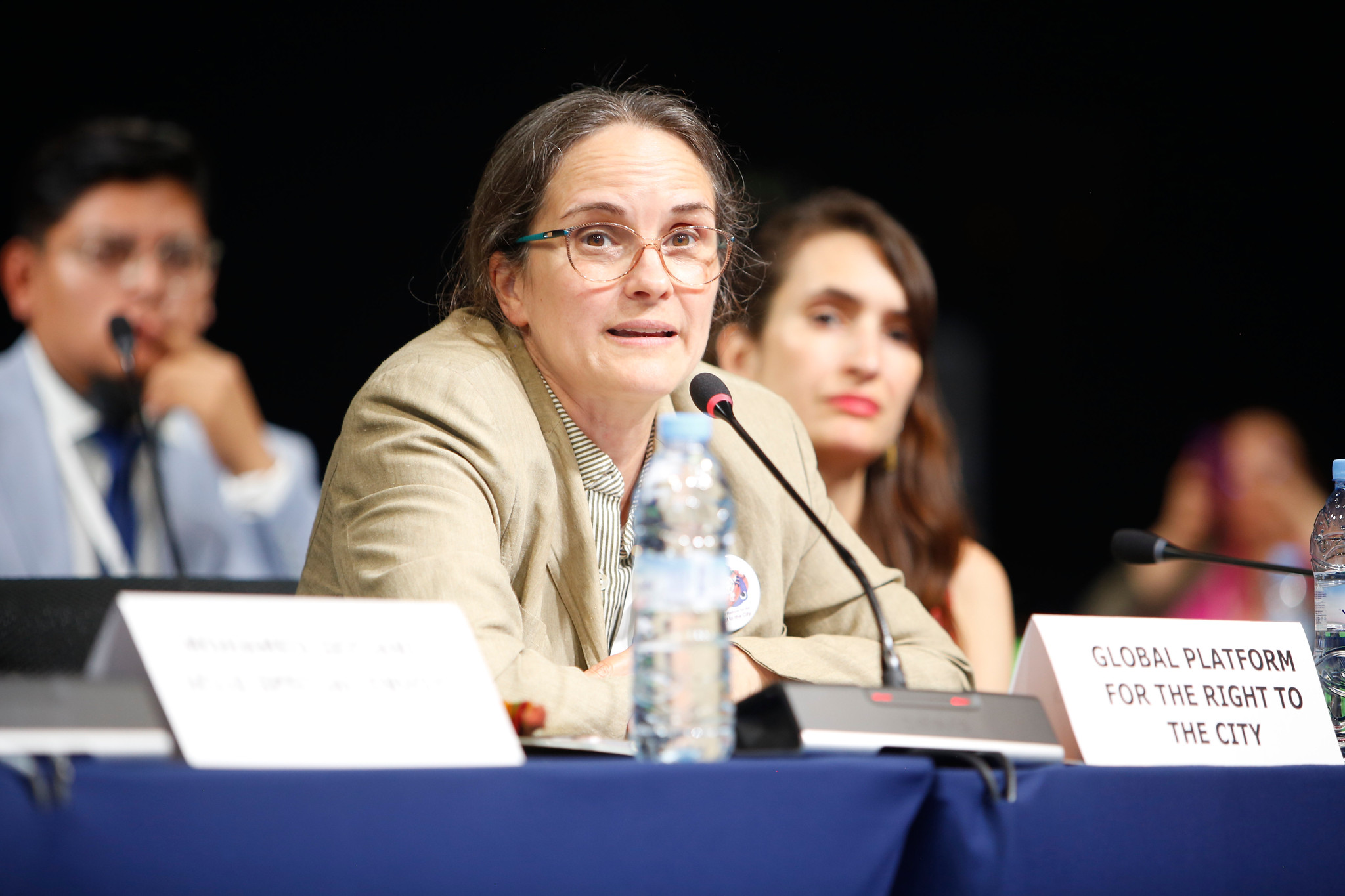
Lorena Zárate, coordinator of the Global Platform for the Right to the City
The Congress marks an important milestone for the Local Social Covenant. From your perspective, what is its greatest achievement, and what should happen next?
The Congress can be seen both as a point of arrival and a point of departure; a key moment to showcase diversity and ongoing initiatives, together with a political commitment on a shared agenda for the years to come. The Local Social Covenant provides a powerful framework for joint action between UCLG members and partners, opening avenues for strengthening the internal and external work through existing and new alliances. Four key features of the 2026 Congress are worth highlighting in that regard: the growing mobilisation and contributions from the Women’s Assembly and the feminist municipalism; the inclusion of strong voices from Indigenous Peoples; the institutionalised engagement of public service workers; and the structured dialogues between civil society and local and regional governments.
The Covenant calls for a renewed social contract built through stronger partnerships between local governments and civil society. Where do you see the most promising areas for joint action?
We firmly believe that public-community partnerships are the way forward. Multiple experiences from around the world show the power of different types of collaborations between local and regional governments and civil society organisations to guarantee universal and affordable public services, while protecting the commons and advancing social justice and climate action. Formalised agreements, legal frameworks and public procurement instruments are key to provide continuity and support the role of the social and solidarity economy and the care economy sustaining our cities and territories.
How can local governments and civil society maintain meaningful engagement beyond the Congress? What mechanisms or spaces for collaboration would you like to see strengthened or shared more widely after Tangier?
Spaces for structured dialogue and mechanisms for collaboration between local and regional governments and civil society organisations should be considered crucial for UCLG everyday work. Permanent and stronger participation of grassroots, NGOs, professionals and academics within UCLG thematic commissions, regional bodies and policy councils seem like an organic pathway to keep exploring. Formalised civil society engagement at the Global Task Force could also be considered in the near future. Within the new mechanisms envisioned by the Local Social Covenant, the new International Public-Community Council on Everyday Essentials has the potential to become a fruitful place for combining municipal experimentation and collective learning with global mobilisation and advocacy at multilateral arenas.
What contribution can your organisation bring in implementing the Local Social Covenant over the coming years?
The Global Platform for the Right to the City (GPR2C) is an open space for collaboration and joint action between multiple actors and across regions. As a flexible organisation, the GPR2C combines thematic and sectorial contributions with an integral vision and shared commitments towards socio-spatial justice, local democracy and the collective management of the commons. Through research, capacity building, communication, policy recommendations and advocacy, GPR2C members and allies promote local transformation and influence global agendas. We are now close to a two-decades-long partnership with UCLG and can contribute with that shared institutional memory in moving forward.
When we meet again at the next UCLG World Congress, what would you hope to have achieved through the Local Social Covenant? What would success look like?
We hope that the Local Social Covenant can become a politicalpractical framework for connecting and transforming cities and territories, strengthening local voices in defense of peace, care, dignity and the planet. An instrument for expanding the horizon of possibilities, promoting and documenting collaborative initiatives across its thematic areas and new mechanisms. Of particular relevance in that regard is the New Charter-Agenda for Human Rights in the City, as an innovative and crucial roadmap able to bridge and push forward the commitments and recommendations included in the 2030 Agenda, the New Urban Agenda (2016-2036) and the upcoming IPCC report on cities (2027). Success would look like renewed trust in each other; in the institutions we create and our ability to do things together. Success would look like permanent dialogue, selfreflection and accountability. Success would look like hope in collective wisdom and ancestral intelligence.