

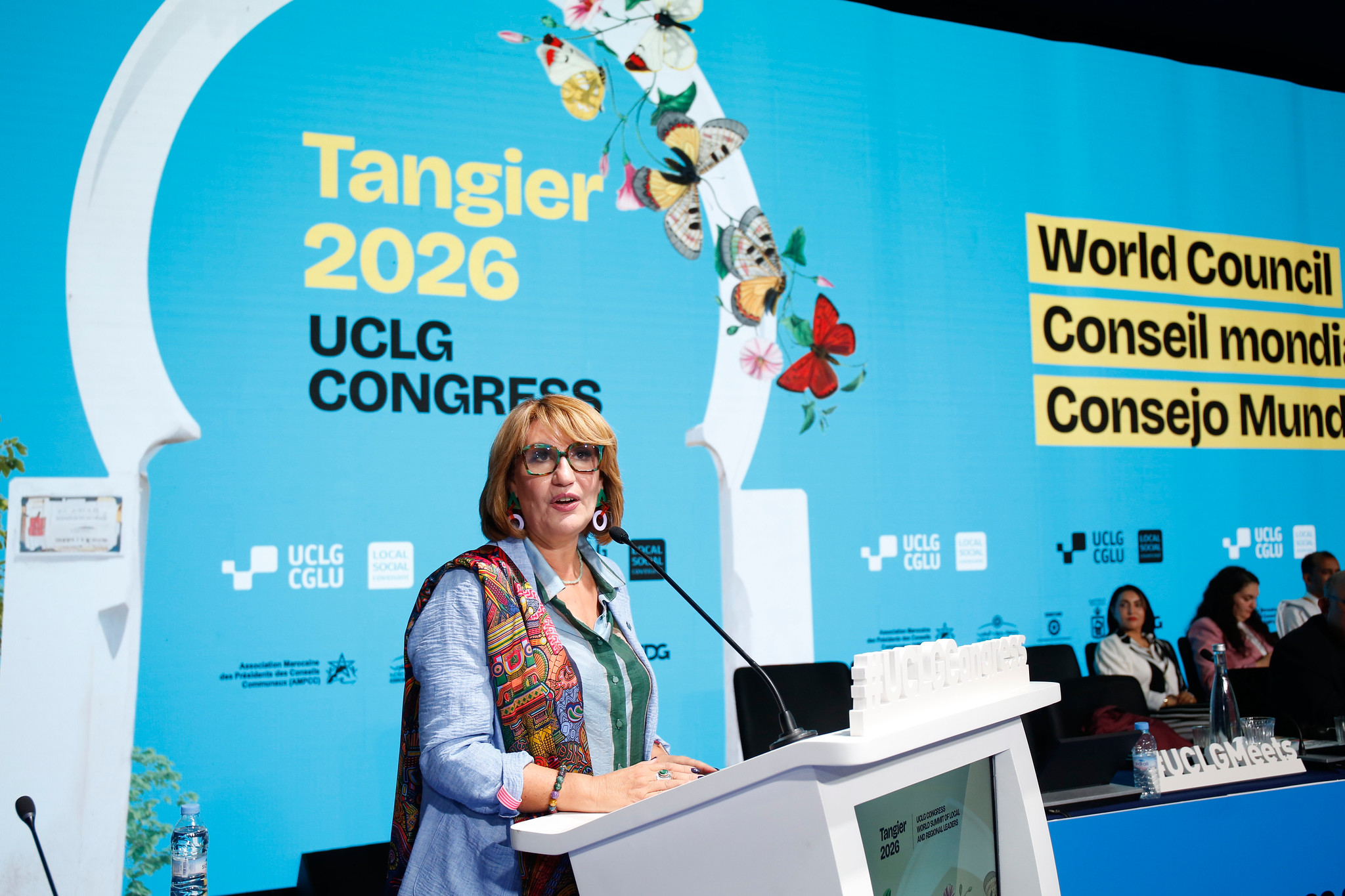
Emilia Sáiz, Secretary-General of United Cities and Local Governments (UCLG)
The international community is entering a decisive moment. As the 2030 Agenda approaches its final stretch and discussions on what comes next begin to take shape, multilateralism faces a fundamental challenge: not simply how to respond to increasingly complex global crises, but how to rebuild trust, strengthen cooperation and deliver meaningful change across every level of governance.
The UCLG World Congress and World Summit of Local and Regional Leaders in Tangier marked an important moment in that conversation. More than another international gathering, it represented the culmination of an unprecedented political process that brought together local and regional governments, civil society and international partners around a common ambition: to place territories at the centre of global governance.
The question was no longer whether local governments should contribute to multilateralism, but how the multilateral system itself should evolve to better reflect the realities of implementation.
The Tangier Outcome Document offers a clear answer. It presents a renewed vision of local multilateralism in which cities and regions are recognised not simply as implementers of global agendas, but as political partners in shaping them. It calls for stronger multilevel governance, renewed democratic institutions, and a new generation of universal, accessible and non-discriminatory local public services as the foundations of sustainable development, equality, peace and resilience.
At a time when trust in institutions is under pressure across many parts of the world, the Tangier Outcome Document builds on our Local Social Covenant by recognising that the major global transitions—climate, demographic, technological and economic—must ultimately be managed where people live, through local institutions capable of integrating housing, care, food systems, public health, local finance, culture and climate action into coherent public policies.
These outcomes reflect a broader shift taking place across the multilateral landscape. The challenges facing the international community are increasingly interconnected, while the institutions created to address them often remain fragmented. Delivering the Sustainable Development Goals, implementing the Pact for the Future and designing the post-2030 development framework will require governance systems that are more collaborative, more accountable and better connected across all levels of government.
The real test, however, begins now. Political momentum is valuable only if it leads to lasting institutional change. The commitments emerging from Tangier invite governments and international organisations alike to strengthen the role of local and regional governments within global decision-making, expand support for localisation and subnational reporting, invest in universal local public services, and ensure that future international agreements are designed with implementation— not only ambition—in mind.
As discussions on the post-2030 agenda gather pace, and with the 100 days of local multilateralism behind us, our Summit provided a political compass for the next generation of multilateralism: one that is more inclusive, more grounded in communities, and better equipped to deliver meaningful change. If this vision is carried forward, the legacy of Tangier will not simply be another declaration, but the consolidation of a multilateral system that finally recognises that global transformation begins locally.