

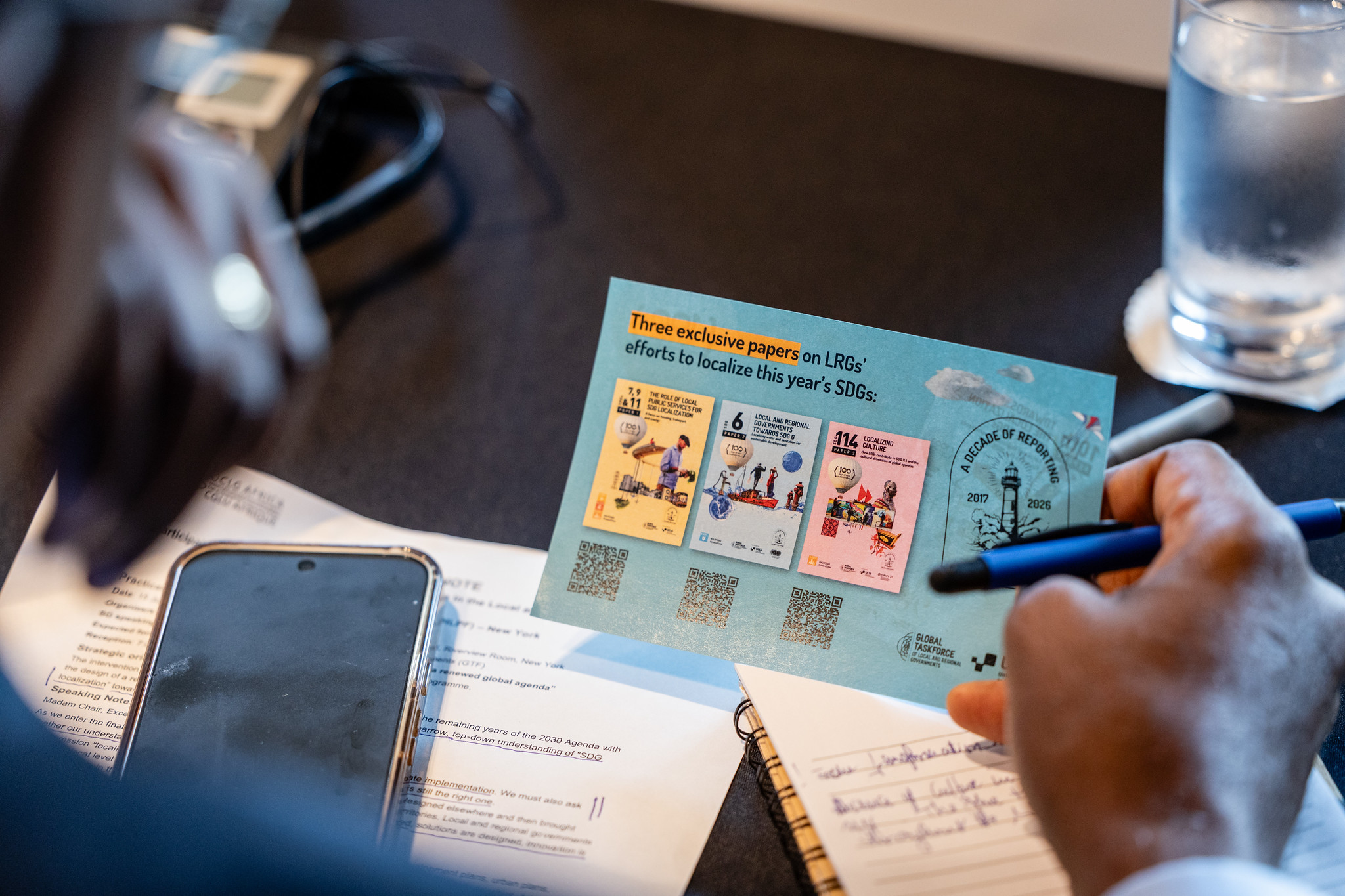
If the 100 Days of Local Multilateralism demonstrated anything, it is that the international municipal movement is unified, strong, resilient and bold. Across the World Congress in Tangier, the High-Level Political Forum and the High-Level Meeting on the New Urban Agenda, local and regional governments consistently reaffirmed their role and contribution to global agendas. They are ready to ensure that multilateral institutions evolve to reflect the reality that sustainable development is increasingly delivered—and shaped—in territories.
Five demands are at the centre of the common and joint advocacy:
A permanent place in global decision-making
Local and regional governments are seeking a stronger and more permanent standing within the coordination of the Sustainable Development Goals and the United Nations system—not only as implementers or providers of data, but as partners in shaping global priorities. The call for stronger multilevel governance, greater institutional recognition and a more structured political dialogue ran through every major milestone of the 100 Days, reflecting a shared ambition to move from consultation to co-governance.
Financing that matches the mandate
Subnational governments account for around 55 per cent of global public investment, yet continue to operate within financial systems that were not designed for the responsibilities they now carry. The demand is not simply for more funding, but for financing mechanisms that reach territories directly, strengthen local fiscal capacity and recognise municipalities and regions as strategic partners in delivering global commitments.
Public services, care and decent work as democratic infrastructure
The Global Framework Agreement on Social Dialogue and Cooperation signed by UCLG and Public Services International reinforced a message that resonated throughout the political cycle: quality public services depend on quality jobs. Social dialogue, fair working conditions and investment in the public workforce are not labour issues alone—they are fundamental conditions for resilient institutions, effective local governance and democratic trust. Care should be recognised as essential social infrastructure and as a public responsibility requiring investment, governance and stronger integration into global development agendas.
Rights and equality with accountability
The Global Charter-Agenda for Human Rights in the City, the outcomes of the Women’s Assembly and the growing attention to political violence against women in local leadership all argued for stronger accountability mechanisms, dedicated financing and institutional guarantees capable of turning political commitments into measurable progress.
Culture and youth built in, not bolted on
Calls for a standalone Culture Goal ahead of the 2027 SDG Summit and the creation of an Intergenerational Council for Future Generations reflect a broader ambition: to integrate culture and future generations into global governance, rather than treating them as complementary themes.