

When Voluntary Local Reviews (VLRs) and Voluntary Subnational Reviews (VSRs) first emerged, they were primarily seen as reporting tools, allowing cities to assess their contribution to the Sustainable Development Goals.
As the international community enters the final years of the 2030 Agenda, however, that view has evolved. Localisation is recognised as a means of delivering the SDGs, but also as a governance approach capable of shaping how sustainable development is planned, monitored and discussed at every level.
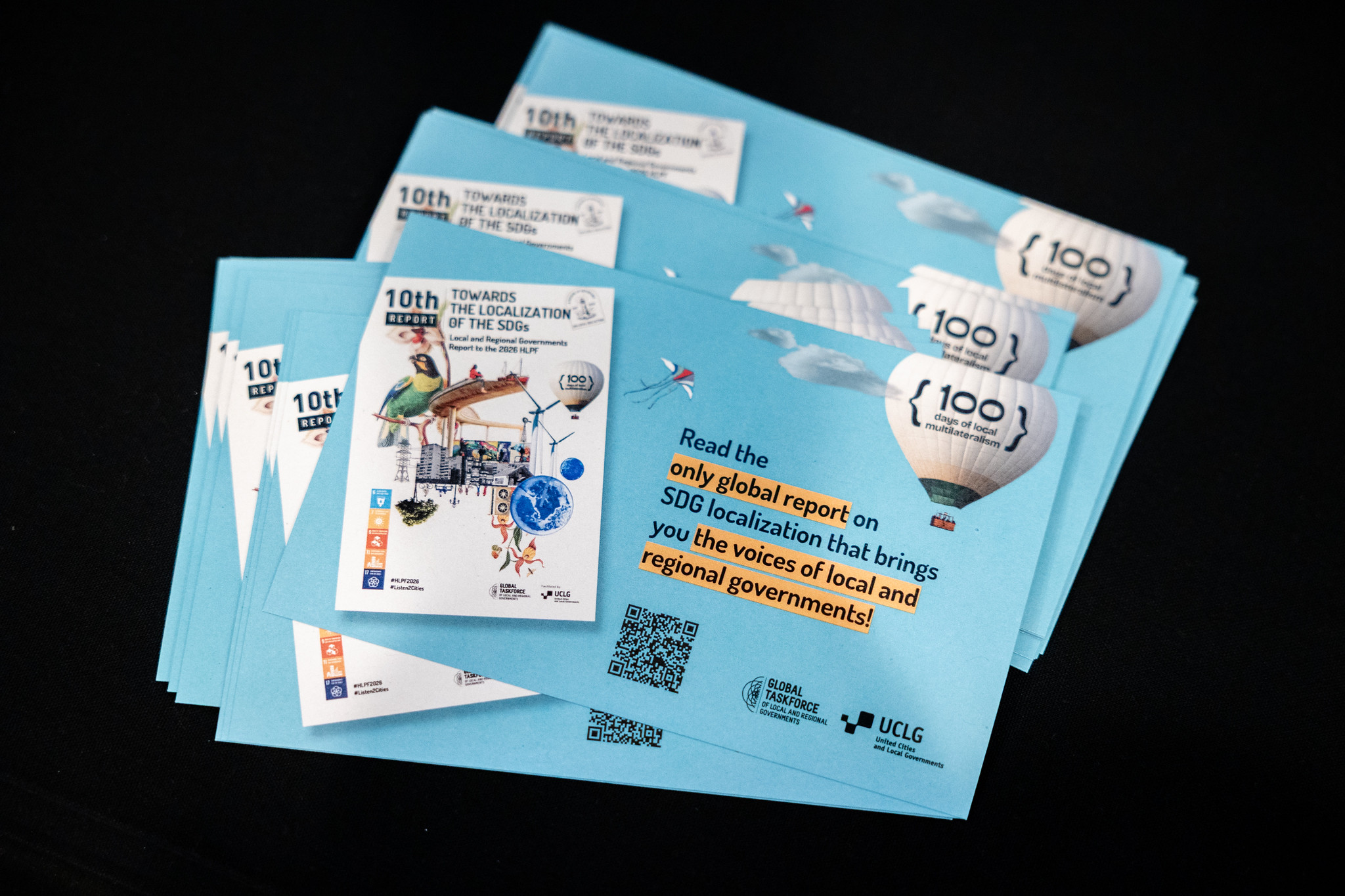
This shift is at the heart of the 10th Report of the Global Taskforce of Local and Regional Governments (GTF) to the High-Level Political Forum, Towards the Localisation of the SDGs. Presented during the High-Level Political Forum on Sustainable Development in New York, the report tells the story of a movement that has grown far beyond its original purpose. More than 500 VLRs have now been completed by 274 cities in 87 countries, representing almost 1.8 billion people. What began as an exercise in measuring progress has become a way of changing how cities plan, govern and work with national governments.
Against this backdrop, the fifth edition of the VLR–VSR Days, held online on 8 and 9 July and co-organised by UCLG, brought together local and regional governments, United Nations agencies, researchers and practitioners to reflect on the next stage of the localisation journey.
Several speakers described how local reviews have become part of the machinery of government. They inform strategic plans, shape municipal budgets, strengthen cooperation across departments, improve the quality of local data and create a common language that connects global ambitions with local priorities. In many cases, they have also transformed relationships with citizens by embedding consultation and participation throughout the review process.
Examples illustrated how deeply these reviews are becoming embedded in public administration. In Strasbourg, the updated VLR showed measurable progress in implementing Agenda 2030. In Malé, the review supported a more integrated model of urban development, while Bilbao used the process to strengthen long-term planning, citizen engagement and evidence-based decision-making. Yokohama has incorporated its VLR into its medium-term planning framework, and Ramallah reported that the exercise transformed how municipal departments understand their contribution to multiple Sustainable Development Goals simultaneously.
The relationship between local and national reporting is also evolving. While VLRs were initially conceived as complements to Voluntary National Reviews (VNRs), several countries are now integrating local evidence into national reporting. Türkiye’s Voluntary Subnational Review drew on more than 600 consultations with municipalities, South Africa now channels local reviews through its national statistics system, and Germany’s latest VNR incorporates contributions from several cities, illustrating how regular dialogue is gradually reshaping national reporting itself.
Discussions nevertheless recognised that significant challenges remain. Funding, political commitment, institutional capacity and data availability continue to limit implementation in many contexts. Yet participants argued that these constraints reinforce the case for stronger localisation: better evidence enables governments to identify priorities more clearly, allocate resources more strategically and strengthen cooperation across institutions.
More information
10th Report Towards the Localisation of the SDGs: Local and Regional Governments Report to the 2026 HLPF
https://gold.uclg.org/sites/default/files/uploaded/HLPF2026. pdf