

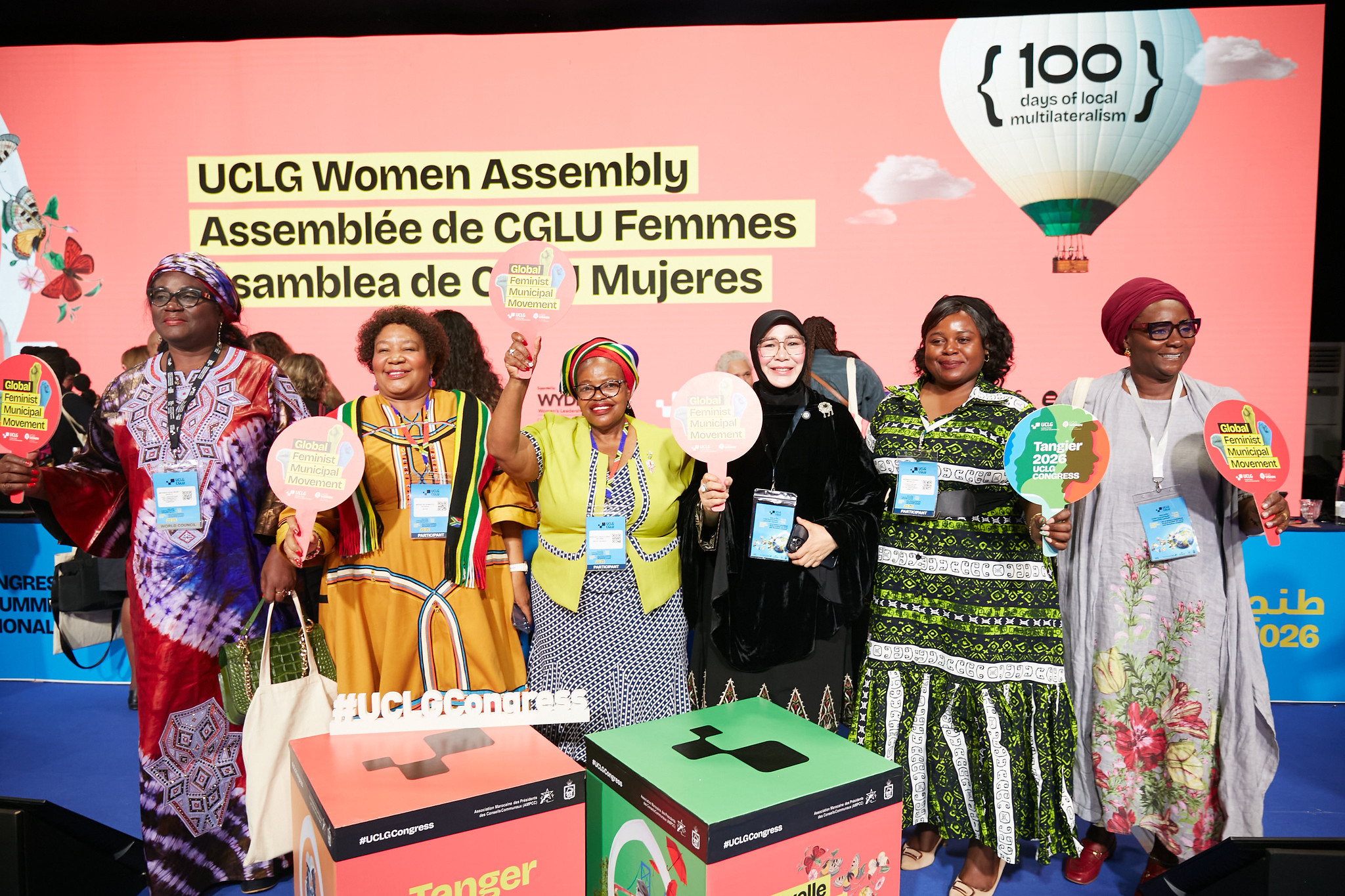
When the 8th UCLG World Congress opened in Tangier on 23 June 2026, it did so with one eye on an ending and another on a beginning. Delegates arrived to close the mandate that began in Daejeon in 2022, and to define the political and organisational direction that will run to 2029.
Over four days, the Congress brought together UCLG’s governing bodies, members, regional sections, civil society partners and international institutions through four interconnected tracks: the Statutory Track, the Assembly Track, the Town Hall Track and the Local4Action Track. They combined institutional decision-making with political debate, co-creation and the exchange of local experiences.
The result was a connected set of outcomes: renewed political leadership, a new political framework, a strengthened Local Social Covenant and a series of organisational mechanisms intended to carry the commitments made in Tangier into the work of the World Organisation.
A political framework for the next mandate
At the centre of the Congress outcomes stands the Tangier Outcome Document: A New Generation of Universal Local Public Services.
The document responds to a global context marked by geopolitical confrontation, democratic backsliding, deepening inequalities, climate disruption, technological transformation and declining trust in public institutions. It argues that these crises are experienced concretely in territories through housing exclusion, food insecurity, unequal access to care, precarious work, environmental injustice, displacement and gaps in essential services.
Its central proposition is that universal local public services constitute the everyday infrastructure through which rights, equality, democracy and peace are made tangible.
Building on the political mandate adopted in Daejeon, the UCLG Pact for the Future, Tangier marks a shift from defining a shared horizon to setting out how that horizon can be translated into territorial action.
A renewed social agenda
The Congress also endorsed the Local Social Covenant for collective action and shared responsibility.
The Covenant emerged from a structured process of dialogue between locally elected leaders, organised civil society and partners. Through the UCLG Policy Councils, the Town Hall and the Letters from the Local Social Covenant, participants identified shared priorities across housing, local finance, food systems, public health, climate justice, cultural rights, local conflict prevention and the new everyday essentials.
Care, anti-racism and youth co-leadership cut across this agenda. Rather than treating these priorities as separate policy sectors, the Covenant connects them through a common commitment to dignity, equality, democratic participation and universal access to quality public services. It is intended to guide UCLG’s strategic alignment and collective action while contributing a territorial perspective to the next global development agenda.
From commitments to organisational action
Tangier also established a set of mechanisms intended to connect the Outcome Document with UCLG’s work programme.
These include the New Global Charter-Agenda for Human Rights in the City, the Housing Justice Academy, the Global Social Dialogue Agreement with local public service workers, the Intergenerational Council for Future Generations, the International Public-Community Council on Everyday Essentials, the Global Facility for Innovation in Local Public Services, the Women’s Council for Equality and the Board on Decentralized Cooperation.
Their functions differ, but they share a common purpose: to turn commitments into spaces for cooperation, learning, accountability and delivery.
Collectively, they address issues ranging from rights-based local governance and housing justice to decent work, feminist municipalism, public-community partnerships, innovation, youth leadership and territorial cooperation.
A renewed political leadership
The Congress elected Uğur İbrahim Altay, Mayor of Konya, as President of UCLG for the 2026–2029 mandate and renewed the composition of the Presidency, the World Council and the Executive Bureau.
The new governing bodies will be responsible for guiding the Organisation’s priorities and ensuring that the commitments adopted in Tangier are reflected in its programme of work over the coming years.
UCLG Presidency
President
Uğur İbrahim Altay,
Mayor of Konya
Co-Presidents
Fatimetou Abdel Malick
President of the Standing Committee on Gender Equality,
President of the Nouakchott Region
Aysen Nikolaev
Head of the Sakha Republic
Bheke Stofile
President of the South African
Local Government Association (SALGA)
Jan van Zanen
Mayor of The Hague
Berry Vrbanovic
Mayor of Kitchener
Cristian Zamora
Mayor of Cuenca
Treasurer
Fatiha El Moudni
Mayor of Rabat