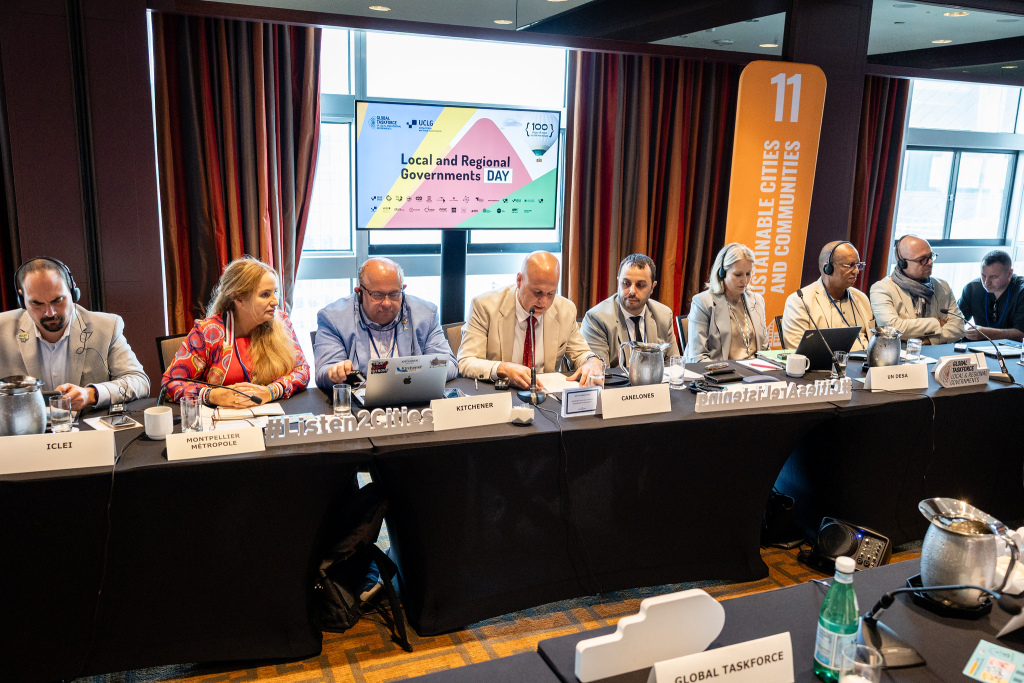
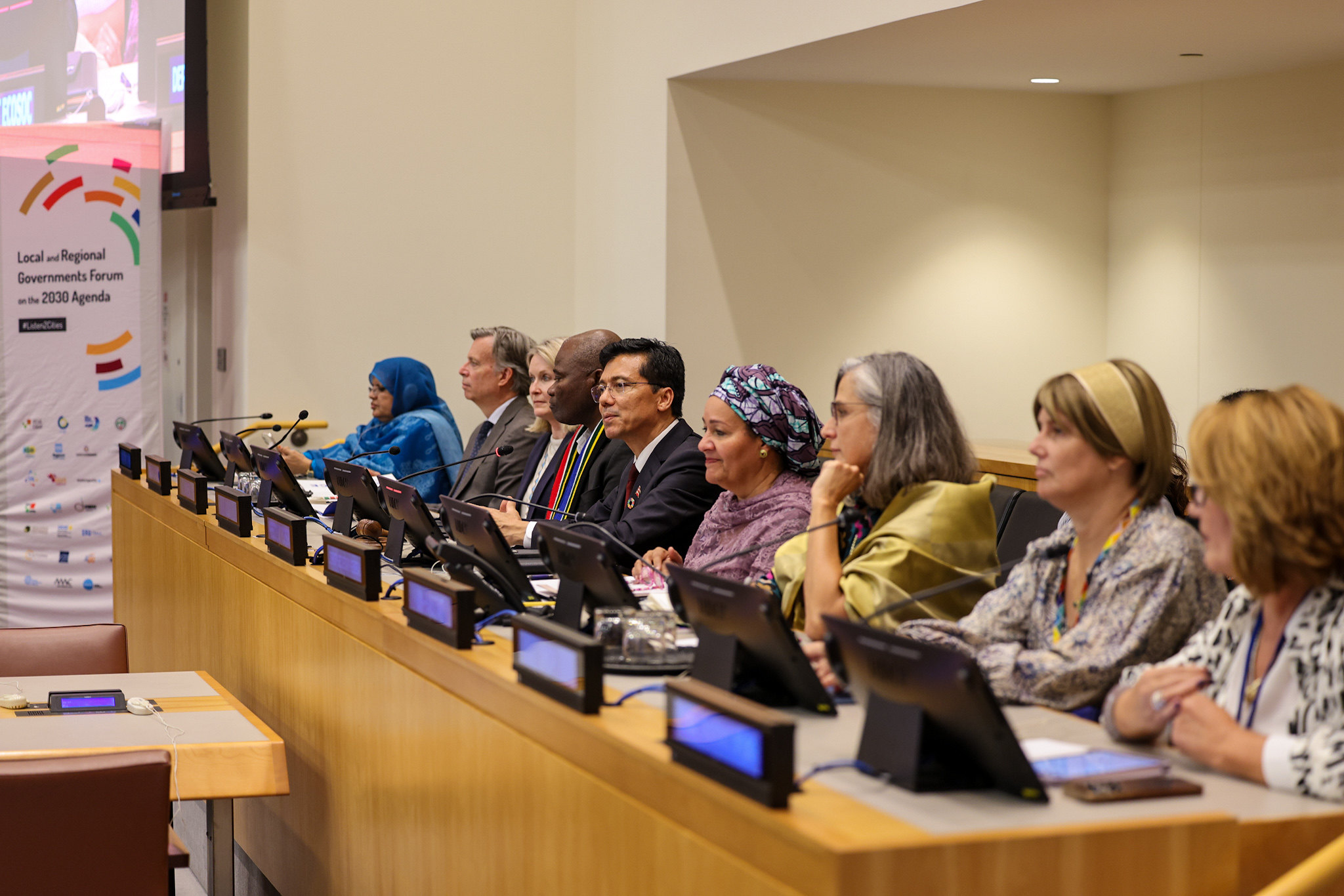
The High-Level Political Forum on Sustainable Development (HLPF) represented the final major milestone of the 100 Days of Local Multilateralism, closing the coordinated process that, over more than three months, connected the principal global milestones of the international municipal movement.
The discussions in New York, bridging the Tangier outcomes, revolved around a question that felt more relevant than ever: how can the momentum generated throughout the 100 Days translate into lasting institutional change that embeds local and regional governments as structural actors within the multilateral system?
The 9th Local and Regional Governments Forum, the principal dialogue between local and regional governments, Member States and the United Nations, took stock of a decade of localisation while exploring how territories can move beyond implementing global agendas to helping shape them. As Emilia Sáiz, Secretary-General of UCLG, noted, the Forum is now formally recognised within the HLPF architecture, the result of a decade of sustained advocacy led by local and regional governments in partnership with the United Nations.
With only four years remaining until 2030 and discussions on the post-2030 framework already emerging, the Forum looked beyond reviewing progress to consider how local and regional governments can assume a more structural role in the years ahead.
The urgency of that discussion was reinforced by the latest assessment of the Sustainable Development Goals. ECOSOC President Lok Bahadur Thapa reminded participants that only a minority of SDG targets remain on track, while many continue to progress too slowly or have stalled altogether. Against this backdrop, he argued that the growing number of local reviews demonstrates how implementation is increasingly taking shape in territories, where global commitments become tangible through public action. He stressed that the Sustainable Development Goals are “negotiated globally, adopted nationally and implemented locally”, while United Nations Deputy Secretary-General Amina Mohammed argued that by the 2027 SDG Summit local and regional governments should “no longer have to ask to be heard”, but instead be structurally embedded in the way the United Nations plans, finances and reviews sustainable development.
Bheke Stofile, President of the South African Local Government Association and co-chair of the Forum, linked this institutional debate to the broader geopolitical context. Development, he argued, cannot be separated from peace and stability: when conflicts or climate disasters strike, local governments are invariably the first responders, often without the mandates or resources needed to act effectively. Strengthening decentralisation and giving local and regional governments a permanent place within the multilateral architecture therefore becomes not only a governance question, but also one of resilience and democratic stability.
The Forum’s first working session turned from political ambition to practical experience. National governments, local authorities and international organisations shared examples of how localisation is reshaping public policy, showing that delivering the Sustainable Development Goals requires more than institutional commitment. Spain highlighted governance, financing and accountability as the foundations of effective localisation, Mozambique described two decades of decentralisation that have enabled local SDG reporting, and local leaders from New York, Heidelberg, Geneva, Bilbao, Hoboken and Canelones illustrated how climate resilience, participation, housing and mobility are addressed through integrated territorial strategies rather than isolated sectoral policies.
One of the strongest interventions came from Dario Liguti, representing the United Nations Economic Commission for Europe and the Local2030 Coalition. Challenging the traditional understanding of localisation, he argued that it “shouldn’t be understood as the last mile of implementation but as the mechanism connecting global commitments to results from day one.” He pointed to the growing number of international “road to” processes leading towards Financing for Development, the World Summit for Social Development, COP30 and the World Urban Forum as evidence that territorial perspectives are increasingly informing global negotiations before decisions are taken, rather than simply contributing to their implementation afterwards.
Kamal Kishore, the United Nations Secretary-General’s Special Representative for Disaster Risk Reduction, added another dimension to the discussion, arguing that governments continue to address disasters, climate change and inequality through separate institutional responses despite communities experiencing them simultaneously. He called for adaptation and resilience financing that rewards prevention rather than recovery, while strengthening the links between local evidence and national planning.
The following sessions highlighted the growing interdependence of the Sustainable Development Goals under review—water, energy, infrastructure, sustainable cities and partnerships— and the governance reforms needed to deliver them. Whether discussing drought, housing affordability, climate adaptation or metropolitan transport, speakers argued that local governments are increasingly expected to respond through integrated approaches while continuing to operate within fragmented financing systems. As Germany’s Parliamentary State Secretary Bärbel Kofler observed, “Local action means little without stronger municipal mandates, capacity and funding.”
Housing became one of the dominant themes of the debate. United Nations Special Rapporteur Koldo Casla argued that local and regional governments should not simply be regarded as stakeholders in international debates but as duty-bearers responsible for guaranteeing the right to adequate housing and resisting speculative pressures that exclude communities from their own neighbourhoods. Metropolitan authorities, including Barcelona Metropolitan Area, also called for greater recognition of their responsibilities in delivering transport, housing, water and energy services, warning that responsibilities continue to expand faster than access to financial resources.
The Forum’s third session shifted attention from implementation to governance. Experiences from Italy, Saudi Arabia, Spain, Belgium, Ecuador and other territories demonstrated that localisation has matured considerably over the past decade.
Among the clearest proposals came from Wim Dries, President of the Association of Belgian Cities and Municipalities, who called for the Local and Regional Governments Forum to become more firmly integrated into the HLPF architecture, for local evidence to play a stronger role in global accountability mechanisms, and for UN commitments to be assessed through a territorial implementation lens before they are adopted. “The SDGs will be local, or they will be nothing,” he concluded, echoing a message that resonated throughout the day.
Closing the Forum, Anacláudia Rossbach, Executive Director of UN-Habitat, argued that local governments should never have been treated as the “last mile” of implementation, but rather as the level where funding and policy coherence have too often fallen short. Drawing on the latest global monitoring of SDG 11, she pointed to progress in access to public transport and national urban policies, while warning that housing and access to basic services remain among the greatest global challenges.
UNDESA Assistant Secretary-General Navid Hanif reinforced this message, arguing that localisation has moved from the margins to the centre of the 2030 Agenda and that multilateralism itself increasingly depends on stronger collaboration across all levels of government. He argued that today’s development challenges no longer respect administrative boundaries, making collaboration between institutions not simply desirable but an essential form of public infrastructure for the future of sustainable development.
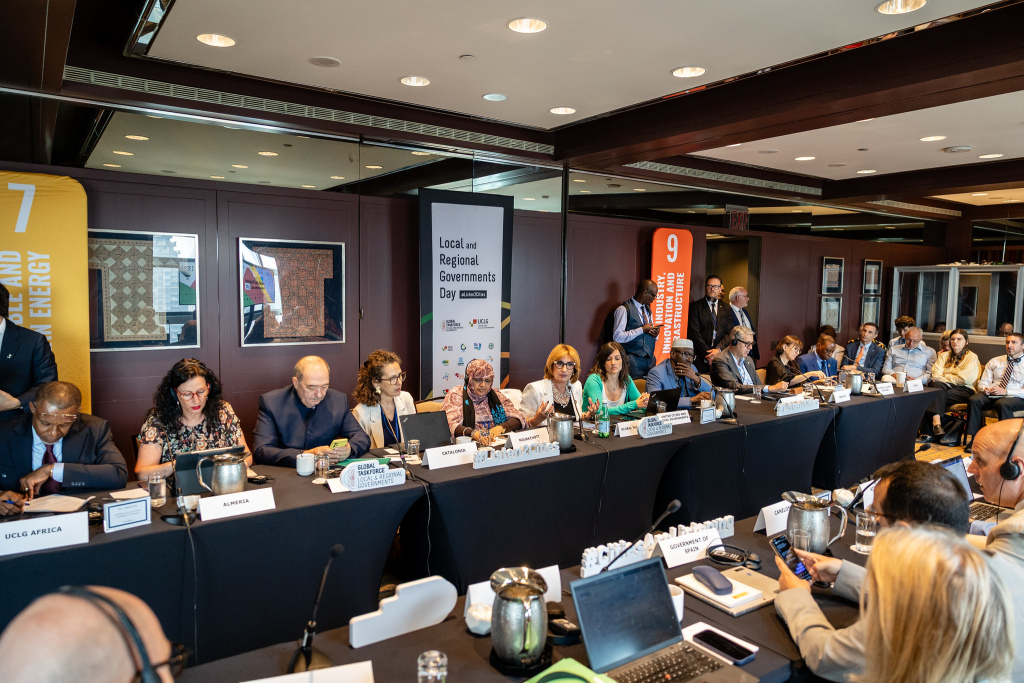
On the following day, the Local and Regional Governments Day shifted the focus from political dialogue to practical action. Discussions examined how Voluntary Local and Subnational Reviews (VLRs and VSRs), territorial data, local public services and multilevel partnerships are strengthening delivery of the SDGs while generating evidence that can inform national and international decision-making.
More than 15 local and regional leaders and elected officials from across the world, as well as local and regional government networks that are members of the Global Taskforce, including ICLEI, UCLG MEWA, UCLG ASPAC, CEMR-CCRE, UCLG Africa, UCLG Eurasia, Cités Unies France and the AIMF; allies such as the Congress of Local and Regional Authorities; partner organisations including Habitat for Humanity International, the Global Alliance for Care and the Peace in Our Cities Network; representatives from the United Nations, UNDESA, the UN Foundation, the UN Youth Office and the Local2030 Coalition; as well as representatives of national governments.
Beyond exchanging experiences, participants argued that the final years of the 2030 Agenda should not become a simple countdown but an opportunity to renew multilateralism by recognising territories as spaces of democratic innovation, implementation and transformation. They also stressed that the post-2030 agenda should be grounded in territorial realities, human rights, caring societies and universal access to essential public services, while calling for local and regional governments to be recognised as political partners in shaping future global frameworks.
The week concluded with the adoption of the Joint Statement of the Global Taskforce of Local and Regional Governments, reaffirming that the achievement of the SDGs depends on empowered local and regional governments, adequate financing, multilevel governance and structured participation in global decision-making. It called on the HLPF to help move local and regional governments from political recognition to institutional transformation, embedding their participation more firmly within the United Nations system and recognising localisation not only as a means of implementation, but as an accelerator capable of renewing sustainable development governance from territories.